How to Destroy Education (And a Nation)

Woman teaching geometry, from Euclid's Elements.
Woman teaching geometry, from Euclid’s Elements. (Photo credit: Wikipedia)
  1. Instead of having instructors rate the scholastic achievements of their students according to effort and ability, rate the performance of instructors by how many of their students pass the class (or a standardized test). Alternatively, rate the performance of teachers by how entertaining their students find them to be.
  2. Turn student assessments over to the same corporation that prepares your textbooks and classroom resources.
  3. Expand online classes and purchase instructional modules prepared by the same corporation.
  4. Use instructional modules for both online and classroom lectures, reducing teaching to rote repetition of corporate-sponsored material.
  5. Tell instructors that the lecture is dead and should be replaced with professionally prepared audio and video materials, conveniently provided by corporate textbook publisher/testing service.
  6. Have students rate professors’ “effectiveness” as teachers.  A study by Scott Carrell and James West found that “student evaluations reward professors who increase achievement in the contemporaneous course being taught, not those who increase deep learning.”
  7. By judging teachers on student success, ensure that teachers at the most selective schools are judged to be the best teachers.
  8. Promote best practices for teaching that are based on the success of teachers at the most selective schools.
  9. Ensure that teachers fear retaliation if sufficient students do not pass their classes. Establish a quota for passing grades.
  10. Give students the impression that they will pass the class no matter how little work they do (see previous). A blog post by Richard Vedder notes that a National Bureau of Economic Research study by Philip Babcock and Mindy Marks found that “In 1961, the average student spent 40 hours a week engaged in their studies—attending class and studying. By 2003, this had declined by nearly one-third to 27 hours weekly.” Probably gotten worse since 2003. Students are doing less and less work while simultaneously being rewarded with better grades.
  11. Cut funding for education, forcing colleges to seek “public-private partnerships,” which enable corporations to determine the educational objectives of the college.
  12. Have adjuncts teach most of your classes with low pay and no benefits.

Is Bill Gates a Trojan Horse?

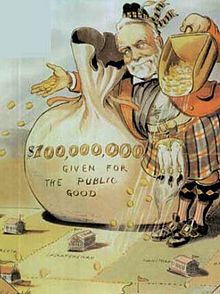
Bill Gates gives away huge sums of money. I could provide some links here to verify that he gives away huge piles of cash, but, really, is anyone going to claim he does not? It is obvious that he could not give away so much money if he did not happen to have enormous bank balances to begin with. So, thank goodness Bill Gates was able to become so insanely rich. And thank goodness all those corporate sponsors of aid were able to amass gigantic storehouses of funds to distribute globally to alleviate poverty and disease while promoting free markets and democracy. Except maybe it is not that simple.Andrew Carnegie

Andrew Carnegie saw philanthropy as a duty of the wealthy. The mere fact that someone was able to obtain great wealth is evidence enough for man that that person is a great judge of what should be done with the money. The wealthy must serve as role models and administer funds in ways that are good for the poorer members of society, even if their choices are not popular. Carnegie said:

“This, then, is held to be the duty of the man of Wealth: First, to set an example of modest, unostentatious living, shunning display or extravagance; to provide moderately for the legitimate wants of those dependent upon him; and after doing so to consider all surplus revenues which come to him simply as trust funds, which he is called upon to administer, and strictly bound as a matter of duty to administer in the manner which, in his judgment, is best calculated to produce the most beneficial results for the community–the man of wealth thus becoming the mere agent and trustee for his poorer brethren, bringing to their service his superior wisdom, experience and ability to administer, doing for them better than they would or could do for themselves.”

Apparently, the wealthy fear giving the money directly to the poor might corrupt them or tempt them to bring about their own destruction. So, the benevolent man of means, and Carnegie does not mention women of wealth, should work for the care and improvement of the lower classes.

And in doing so, the wealthy establish not only their honor, but also their power. As Thomas Hobbes said, “There can be no greater argument to a man, of his own power, than to find himself able not only to accomplish his own desires, but also to assist other men in theirs: and this is that conception wherein consisteth charity.”  Through charity, the wealthy shape the aspirations of society, the resources for improvement, and the goals of the impoverished. The poor cannot be trusted to make autonomous decisions about what is good and proper for the course of society. In order to receive the generosity of the powerful, the weak must assume a position of obedience and servitude. The superior minds will lead with love if only the grateful masses will follow.

But it does not end there—the wealthy engage in a kind of philanthropy that actually seeks to oppress and exploit the poor. This is true in many instances, but it currently most obvious in some forms of foreign aid donations.

In the current political climate in the United States, we often hear that aiding people engenders a culture of dependence. Most people imagine that the recipients of aid become too lazy to work for their own improvement, but that is not how aid creates dependence. Rather, it can create dependence by destroying any possibility of self-sustaining local markets. Economist Dambisa Moyo sums up the problem of aid to Africa when she says, “One wonders how a system of flooding foreign markets with American food, which puts local farmers out of business, actually helps better Africa.” Michaela Schieesl made a similar point, saying, “The United States spends $1.2 billion on food for the world’s hungry, making it the biggest provider of food aid. It is also the biggest contributor to the UN’s World Food Program (WFP). But this seemingly charitable commitment comes with a major hitch: Instead of donating money, the United States donates food, almost all of which it produces itself.”

The US donates food not as a means of helping struggling societies, but rather as a means of subsidizing American farmers and agribusiness. By dumping free food grown in the US, farmers in foreign countries are put out of businesses. Of course, if they turn to alternative crops such as poppy, coca or even tobacco, the farmers are condemned for contributing to the global drug trade and supporting violence and addiction.

The ETC Group in Canada now warns us of another scheme to use philanthropy to help entrench monopoly powers of transnational corporations under the guise of aiding poor farmers:

“The world’s two richest men – Bill Gates and Mexico’s Carlos Slim – are working with CIMMYT (the International Maize and Wheat Improvement Center) to make bargain GE seeds and traits available to farmers in the global South. The notion that farmers will benefit from a post-patent regulatory regime and Gene Giant charity is patently absurd.”

This international aid effort has the effect of ensuring more and more of the world’s food production will be controlled by transnational corporation promoting market-based “solutions” to global food insecurity. The ETC Group notes that the World Economic Forum’s New Vision for Agriculture, which includes all the giant gene producers, describes itself as working with G8 and G20 to “foster multi-stakeholder collaboration to achieve sustainable agricultural growth through market-based solutions.”

Not all aid is bad, however, and giving can save and improve lives. Moyo and other critics of aid are quick to point out the difference between rescue or relief aid and aid that permanently alters economic structures. My opinion is that smaller donors tend to choose charities based on how they relieve suffering rather than how they either guide, manipulate, or oppress the poor. Modest earners give a higher percentage of their income than the super rich.  In an article for The Atlantic, Ken Stern noted,  “In 2011, the wealthiest Americans—those with earnings in the top 20 percent—contributed on average 1.3 percent of their income to charity. By comparison, Americans at the base of the income pyramid—those in the bottom 20 percent—donated 3.2 percent of their income.”   Stern added that among donations from the wealthy,  “Not a single one of them went to a social-service organization or to a charity that principally serves the poor and the dispossessed.” More modest earners are more likely to look out for the interest of the poor.

Addressing income inequality would have two positive effects: First, it would help alleviate the need for any aid. Second, it would help more modest earners to give more and give more effectively. And, no, lifting people off the floor will not make them behave as those at the very top (in the stratosphere of wealth disparities). Rather, as the poor enter the middle class, they give more than the super wealthy and give with an aim to relieving suffering and not to creating monopoly power or consumer dependence.

Also, be sure to read Peter Buffett’s comments on the same subject here.

Finally, for an example of a charity operating from the ground up, please see Shoulder to the Stone.

[youtube=http://www.youtube.com/watch?v=UlnLojVPacM]

Teaching Ethics to Greedy Bastards

When a corporate executive, high-powered lawyer, or well-funded medical researcher is exposed for egregious unethical behavior, we often say it would have been a good idea for that person to have had a class in ethics with some follow-up training. We’d like to think that with the proper ethics training even the most heartless sociopath could be encouraged to at least follow some of the rules.

And if we can’t (note: we can’t) encourage bad people to be good people, what are ethicists worth? Well, our roles fall into several categories: 1. Providing ethical answers to dilemmas. 2. Offering ethical analysis of a particular problem. 3. Teaching ethical decision-making, which makes a good-faith assumption that the decision maker is sincere in wanting to be ethical. 4. Holding wrongdoers accountable for their behavior.

The first category is offered to clients who don’t want to take complete responsibility for their ethical decisions. Once a professional ethicist has offered an opinion on whether something is above board, an organization can say, proudly, “All our policies and procedures have been reviewed by someone with extensive training and expertise in ethics and found to be compliant with all ethical and legal codes.” Indeed, it can be a very good idea for an organization to get an outsider to review policies for possible ethical problems.

The second category is related, perhaps a subset of the first. When institutions encounter a particularly sticky issue, they might ask an ethicist to help them work through all the ethical considerations and explore how various ethical theories can help them solve the dilemma. Again, a useful role for the ethicist.

The third category involves training. Rather than giving answers to ethical questions, the ethicist can teach motivated individuals to analyze various conflicts on their own. Most people know how to think ethically, but they sometimes forget some of the considerations that professionals might find to be second nature.  Developing a more thorough approach to ethical approaches can benefit individuals and organization alike. It cannot, however, turn a bad person in to a good one. Evil people don’t lack ethical tools—they lack a conscience.

So, what do we do about the evil people? An important role for ethicists, in my considered and passionately held opinion, is to cry foul when individuals and institutions engage in egregious behavior. And when ethicists disagree on what is an egregious action, fervent debate erupts in the public sphere, benefitting the public and everyone involved, or so it should be. When ethicists sound the alarm that some behavior is abhorrent and shameful, a public chorus against such actions can at least ensure that the bad actors confront public scrutiny.

Think it doesn’t work? Remember in 2011 when executives at Transocean received bonuses for their safety record after the explosion in the Gulf of Mexico killed 11 and sent millions of gallons of oil streaming into the water? After public outcry, the executives thought better of keeping those bonuses and donated them to the Deepwater Horizon Memorial Fund. Social regulation pushes and pulls behavior through honor and shame. In responding to abhorrent behavior, Kwame Anthony Appiah says, “Shame, and sometimes even carefully calibrated ridicule, may be the tools we need. Not that appeals to morality—to justice, to human rights—are irrelevant.”

Most of us evaluate ethical theories in the following way: Knowing that I am an ethical person, which ethical theory best fits my behavior? Following this method, we can all justify our actions through theoretical ethics as we simply seek out the theories that validate our behavior. Given that we all have justification for our behavior, public outcry is not likely to immediately shake our perception of what is appropriate, and, indeed, the public rarely speaks as one voice. Further, the common view is often wrong, or so I judge it to be. Bertrand Russell once said, “In view of the silliness of the majority of mankind, a widespread belief is more likely to be foolish than sensible.” Indeed.

Many people, especially those in power, feel their behavior is beyond reproach. They seem to think they could not have gained power if they were not deserving of it. Public outcry and public discourse, can remind them that they are, in common with the rest of us, flawed and fallible human beings. What this means is that we must raise our voices, express what we find shameful and honorable, and join or create a conversation over morality, dignity, and justice. Only when we suppress our voices do we lose. Only our common humanity makes our salvation possible.

Modern Libertarians Hate Thomas Malthus

Whether they are familiar with his work or not, many modern libertarians echo some of the ideas of Thomas Malthus when they advocate austerity in public policy. Most notably, Malthus claimed that the “poor laws” of England of his time deprived the poor of any liberty and independence. He felt that the poor would have more self-respect and freedom if they could provide for themselves and their families through their own labor.

Thomas Malthus

It was Malthus, not Darwin, who first mentioned a struggle for existence. In his 1798 screed, “An Essay on the Principle of Population,” he
wrote,

“Restless from present distress, flushed with the hope of fairer prospects, and animated with the spirit of hardy enterprise, these daring adventurers were likely to become formidable adversaries to all who opposed them. The peaceful inhabitants of the countries on which they rushed could not long withstand the energy of men acting under such powerful motives of exertion. And when they fell in with any tribes like their own, the contest was a struggle for existence, and they fought with a desperate courage, inspired by the rejection that death was the punishment of defeat and life the prize of victory.”

In the essay, Malthus basically argued that hardship limits population but abundance leads to population explosions. For this reason, feeding the poor is a bad idea, as it will encourage wanton reproduction and the survival of infants into adulthood. By helping the poor survive, they would then multiply and deplete the planet of all its resources. It is the wealthy, of course, who consume the most resources, but even at that, Malthus did not have quite the same view of some austerity minded people of the 21st century.

For one, Mathus wanted to protect the value of farm labor. He said,

“Every endeavour should be used to weaken and destroy all those institutions relating to corporations, apprenticeships, etc., which cause the labours of agriculture to be worse paid than the labours of trade and manufactures. For a country can never produce its proper quantity of food while these distinctions remain in favour of artisans. Such encouragements to agriculture would tend to furnish the market with an increasing quantity of healthy work, and at the same time, by augmenting the produce of the country, would raise the comparative price of labour and ameliorate the condition of the labourer.”

Efforts to drive down the wages of farm labor are, then, anti-Malthusian. He also did not believe in leaving the poor with no help for work and redemption. While he objected to the “poor laws” of his day, he did believe in a tax-supported programs to provide employment for the poor. Thus,

“County workhouses might be established, supported by rates upon the whole kingdom, and free for persons of all counties, and indeed of all nations. The fare should be hard, and those that were able obliged to work. It would be desirable that they should not be considered as comfortable asylums in all difficulties, but merely as places where severe distress might find some alleviation. A part of these houses might be separated, or others built for a most beneficial purpose, which has not been infrequently taken notice of, that of providing a place where any person, whether native or foreigner, might do a day’s work at all times and receive the market price for it.”

Public works projects, such as those put in place by FDR, can alleviate much suffering while also benefitting the public good through improved infrastructure and public service. Note that Malthus did not advocate putting poor people in prison and forcing them to work for free.  Malthus did believe in treating the poor with respect and providing opportunities for honest employment for the betterment of society. Modern libertarians would do well to recognize the basic human desire for dignity and self-respect. When we help one another, we are free.

What is Bioethics? Environmental and Economic Justice

Like many people, Peter Singer was the first bioethicist to occupy any space in my consciousness. He first got my attention with his concern for animal welfare and calls for vegetarianism. I suppose he is best known for saying we should not eat animals but that it is sometimes acceptable to kill our babies, which many people find upside down, especially if they haven’t actually read all his arguments, and few of his critics seem to have read his arguments.

But Singer has also spent a great deal of effort offering suggestions on relieving the problems of globalization, wealth inequality, and further destruction of the planet. One can offer reasoned objections to his suggestions, of course, but his choice of topics and concerns helped define what bioethics was for me.

Singer’s concerns fit nicely with the term “bioethics” as originally conceived by Van Rensselaer Potter in 1970. Potter said bioethics should be “a new discipline that combines biological knowledge of human value systems.” Potter saw bioethics as a systematic attempt to ensure the survival of the planet and all the people on it. One of Potter’s goals was to eliminate “needless suffering among humankind as a whole.”

Van Rensselaer Potter

Unfortunately, by the middle of the 1970s, the term “bioethics” had already been co-opted by the medical establishment and applied primarily to medical ethics. Concerns for ensuring the well-being of humankind were replaced by concerns for patients and doctors, with a strong emphasis on patient autonomy. Today’s bioethicists tend to ignore problems that have nothing to do with healthcare or medical research, but millions of people in the world have no access to healthcare and so escape any attention from bioethicists at all, which is itself an injustice.

To be sure, bioethicists are still in the world working for justice and, in some notable cases, the survival of the planet, but those working on themes outside of healthcare or medical research are outsiders at best. (For a couple of examples, see Martha Nussbaum and Thomas Pogge.)

I will continue to argue that this is the wrong approach to bioethics. Potter’s and Singer’s concern for promoting the health of the earth and all its inhabitants is the only reasonable way to think of bioethics, and those who disagree are the ones who should defend their positions.

What are some of the issues we need to address? Just to get us started, we can look at environmental justice, war, climate change, worker’s rights, wealth inequality, access to water, human rights abuses, women’s equality, and children’s welfare. Too broad? The problems that threaten life and health are vast. Medical practice requires an enormous cadre of professional ethicists to develop policy and practice guidelines, of course, but bioethicists following the vision of Potter should be welcome at the table as well.

Bloomberg, human rights, and the ethics of soda

Recently, a New York court blocked New York Mayor Michael Bloomberg’s effort to limit the sale of sugary drinks of more than 16 ounces. The court and many individuals feel it is not up to the government to regulate the choices of individuals, even if those choices lead to death. And lead to death they do. A study at the Harvard School of Public Health claims that sugary drinks lead to 180,000 deaths worldwide each year, with 25,000 of those deaths in the US.

It isn’t at all clear whether limiting the size of drinks would reduce the disease burden, but I have to commend Michael Bloomberg for at least saying that the drinks are dangerous, which may help to raise awareness of the problem. The Harvard study links the drinks to the rise in diabetes, heart disease, and cancer. The beverage industry, of course, challenges the methodology of the study.

No one claims, however, that consuming large quantities of super-sweetened sodas is in any way healthful. People can choose to kill themselves with soda, but they should at least be aware of the danger. Perhaps warning labels, similar to those that appear on cigarettes, are in order. Smokers still choose a slow form of suicide, but they can’t claim they didn’t know what they were doing.

One problem with the large drinks, besides the harm, is the pricing structure. I’ve noticed that the largest drinks are often only slightly more expensive than the smaller sizes. Forcing retailers to sell the drinks on a per ounce basis might help achieve Michael Bloomberg’s objectives, though I’m sure this solution would not satisfy free-market libertarians, who are more concerned with private profit than public good.

But this focus on public health ignores a larger problem with the food we eat. As part of its Behind the Brands project, Oxfam recently released a briefing paper on food justice and the big 10 food and beverage companies (Associated British Foods, Coca Cola, Danone, General Mills, Kellogg, Mars, Mondelez, Nestlé, Pepsico and Unilever). The report notes:

“Today, a third of the world‟s population relies on small-scale farming for their livelihoods. And while agriculture today produces more than enough food to feed everyone on earth, a third of it is wasted; more than 1.4 billion people are overweight, and almost 900 million people go to bed hungry each night.”

The report goes on to say, “The vast majority of the hungry are the small-scale farmers and workers who supply nutritious food to 2 – 3 billion people worldwide, with up to 60 percent of farm laborers living in poverty.” The inexpensive food and drink we buy demands conditions that are often horrific for the people who farm and produce the food. Many of us buy drinks sweetened with real sugar to avoid the perceived harms of high-fructose corn syrup, but note that Coca-Cola is the world’s largest buyer of sugar cane, which is associated with rampant use of child labor and unconscionably low wages.

According to CNN, the International Labor Organization “estimates 2.4 million child workers are in the Philippines. Many of them, according to the ILO, are in rural areas working in fields and mines. The organization estimates 60% work in hazardous conditions.” According to Coca-Cola’s website, “A grant from The Coca-Cola Foundation funded the construction of a high school in Bukidnon, which has the country’s highest incidence of child labor and the highest number of school-aged children not working or attending school.” The idea is that the children who are in school will not be in the fields. Also, educated children will be empowered to seek and create better economic conditions and wages.

If efforts to educate children used in the supply chain for sugary drinks actually do reduce the amount of cheap (nearly free) labor, the price of sugary drinks is likely to rise, which may in turn reduce demand for the diabetes/heat disease-inducing drinks in the first place, achieving Mayor Bloomberg’s initial objectives. Will the drop in demand eliminate job prospects for the world’s farmers? The ethics of food, and drink, is complicated.

Ron Paul, Murray Rothbard, and the loss of freedom

Libertarian and conservative critics of progressives seem to endlessly repeat the same refrain that progressives are opposed to freedom and liberty. This generally baffles progressives as they see themselves as the defenders of civil liberties such as free speech, marriage equality, and religious liberty. Listing examples of the liberties they defend does nothing to quell criticism from libertarians, however, as the concepts of liberty that libertarians hold is quite different from the concepts of liberty progressives hold.

For libertarians, all liberty stems from property.  In short, if you have little property, you are not entitled to liberty. Murray Rothbard, who wrote the introduction to Ron Paul’s book, puts this idea quite succinctly in The Ethics of Liberty, saying, “Human rights, when not put in terms of property rights, turn out to be vague and contradictory, causing liberals to weaken those rights on behalf of ‘public policy’ or the ‘public good.’” In other words, when progressives seek to ensure that all people enjoy the same rights, Rothbard and other libertarians claim this actually denies human rights as it causes some individuals to lose some of their property.

So, your right to free speech, for example, depends on your owning enough property to exercise your speech. Otherwise, it depends on the goodwill of some property owner to permit you to speak. As Rothbard puts it, “There is no such thing as a separate ‘right to free speech’; there is only a man’s property right: the right to do as he wills with his own or to make voluntary agreements with other property owners.” And, of course, libertarians feel that all property should be privately held.

So, when Occupy Wall Street protesters are chanting “Whose streets? Our Streets!”, they are going directly against the beliefs of libertarians. Protesters have been evicted around the country on the basis that they are on “privately held” public spaces. You can try protesting conditions in Foxconn plants outside an Apple store to test how much freedom you have on privately held property. Progressives seek to establish publicly held property to ensure that everyone (or as many as possible) has an opportunity to exercise the right to free speech. The same applies to public airwaves and Internet bandwidth.

If you want to be able to speak publicly, you must be a property owner. To have a significant voice, you must own a great deal of property. When the Supreme Court ruled that unlimited political contributions were a matter of free speech, this is really the underlying theme to their proclamation. When George Carlin declared that the owners of this country were the only ones with any freedom, some regarded him as a crazy conspiracy theorist.

Philosopher Isaiah Berlin famously helped distinguish between two kinds of liberty. Negative liberty is the freedom from interference from others. Positive liberty is the ability to act in the way one chooses. Progressives hold that liberty is meaningless to a person who has no means to act or make choices. Libertarians hold that all liberty is negative (freedom from coercion) and all rights are negative (no one is obligated to ensure that you have positive liberty).

When libertarians and progressives talk to one another, they should at least try to understand how the other is using basic terms such as rights and liberty. As for me, I completely understand why wealthy people would be libertarian. I find it much harder to understand why people who have little property (and that is most of us) would embrace these libertarian ideas.

[youtube=http://www.youtube.com/watch?v=hYIC0eZYEtI]

Why my students love Ayn Rand

I think my Introduction to Ethics class is fairly typical. We start with Epicurus and work our way through Aristotle, Jeremy Bentham, John Stuart Mill, and Immanuel Kant. After those heavy hitters, I try to lighten things up with some essays from contemporary philosophers (in the most general interpretation of the term). So, after reading some Kant, I move to an interview with Ayn Rand for a little break.

This may not be such as good tactic. When I first chose the assignment, I did so because the interview reveals Rand’s beliefs in a way that is stark and easily digested. I assumed anyone reading it would agree with me that her philosophy is reprehensible, and I would be serving the greater good of humanity by having them exposed to it. I try not to reveal my biases in class, and I really don’t want to tell them what to believe. I just hope they will hate Rand. I’m less concerned about what they will like.

Nonetheless, I always have a few students who declare that Rand is the first reading they have liked. I ask probing questions hoping to find that maybe they didn’t really get what she was saying, simplistic as it is, but I generally have to concede that they really do like what she says. As a result, I think I have created a small band of ardent Rand supporters over the years. The Tea Party can thank me. And I think I’ve identified the two reasons she is so popular with students:

1. As I mentioned, the assignment is easy to read and digest. After slogging through Mill and Kant, I can certainly understand why they would be relieved to find something they can understand on the first pass, even if the reading completely flies in the face of their supposed religious convictions. But the second point is more meaningful to me.

2. Rand is easy in another sense as well. She really doesn’t demand much of her readers. She tells them they must be selfish and pursue only what is truly gratifying to them. Now, Epicurus said that they should seek a pleasurable life through contemplation and serious examination of the world around them with great respect for their community. Aristotle tells them they must practice constantly to become virtuous in a way that will enable not only their personal flourishing but the success of their society. Mill tells them to seek their own pleasure but that they will derive the greatest satisfaction from pleasures that require much practice and refinement to achieve. And Kant tells them they can’t lie under any circumstances. Furthermore, they must help people who are worse off than they are. To follow Kant or any of the others, they would have to put out a great deal of effort to change how they live, but to follow Rand’s advice they don’t see that much more effort is required. In their minds, at least, they are already living Rand’s ideal life. And, they get to feel pretty self-righteous comparing themselves to recipients of government aid (my students do not consider low community college tuition to be a form of government support).

I suppose I am hopelessly naive to think my students will take my class looking for hints on possible self improvement. They are seeking validation for their current lifestyles, not ideas on how to improve.

Except when they are not seeking the easy way. It is easy for teachers to get discouraged and forget all the talented and hard working students who are in constant search of new information and new challenges. Many of my students have now gone on from the community college to universities and graduate school. They have admirable careers in fields such as law, science, health, and social work. I am humbled by them.

http://www.youtube.com/watch?v=K9mJpVf4dkc

For further reading:
1. 10 (insane) things I learned about the world reading Ayn Rand’s Atlas Shrugged
2. How Ayn Rand Seduced Generations of Young Men and Helped Make the US into a Selfish, Greedy Nation

What Makes the Trayvon Martin Case Different From Other Murders

I did not intend to make any comment about the Trayvon Martin case as I thought there was plenty of thoughtful commentary on it already, but I’ve been reading too  many blogs on it today, and it seems to me that many people are missing the point. As I see it, it does not matter whether George Zimmerman is Hispanic. It doesn’t matter whether Trayvon got into trouble in school (how many teenaged boys never get in trouble at school?), wore gold fronts on his teeth for a camera, or tried to act tough. If Trayvon’s problems make him deserving of death, then many people I love and admire would fall in the same category. How many of us want to be judged for the decisions we made when we were 16 and 17 years old? And it doesn’t matter that many other teenagers are murdered every year. This case is different.

It is different because of the police response to it. It is different because the police say they did not have enough evidence to arrest anyone, but they do not appear to have made much effort to gather evidence. They seem to have spent more time trying to find evidence Trayvon was up to no good than they spent trying to find out whether he was the victim of stalking and murder. The police seem to have dismissed the case as just another death of a young, black criminal. They seem surprised that anyone cared enough about Trayvon to pursue the case and try to get the facts.

Yes, it is a tragedy when anyone is murdered, but it is an outrage that young men of a particular color are viewed as disposable human beings by many in our society. That someone’s life could be of so little value that it is deemed unworthy of investigation is appalling.

Don’t force me to pay for your religious practice

Members of the Catholic Church have expressed outrage that the new health laws require them to provide contraception to women. This was weeks ago, but Catholics continue to double down on this position. They say the state has no right demanding that they violate their own religious beliefs.

This argument makes perfect sense. The government has no right telling private individuals how they should conduct their affairs. So long as they aren’t taking public money, serving the general public, or hiring non-Catholic employees, there should be no controversy at all.

But according to an article in Mother Jones:

Under Obama, Catholic religious charities alone have received more than $650 million, according to a spokeswoman from the US Department of Health and Human Services, where much of the funding comes from. The USCCB, which has been such a vocal critic of the Obama administration, has seen its share of federal grants from HHS jump from $71.8 million in the last three years of the Bush administration to $81.2 million during the first three years of Obama. In fiscal 2011 alone, the group received a record $31.4 million from the administration it believes is virulently anti-Catholic, according to HHS data.

Under the first amendment, the government must not establish a religion. Funding of faith-based charities avoids violating the first amendment by demanding that those charities do not use their services to promote their faith or discriminate against those of other faiths.

Requiring them to use public funds to offer public services without discriminating against non-Catholics is not an attack on religion. Permitting charities receiving public funds to discriminate against non-Catholics would be using my taxes to promote religious views I find reprehensible. I am amazed that conservatives, libertarians, and Tea Party members aren’t outraged at this use of taxpayer money. Surely conservatives believe we should trim the federal budget and protect religious liberty at the same time.

If Catholic Charities want to exclude contraception from their health plans and refuse to recognize the rights of same-sex marriages, they should immediately refuse all public funding, including federal, state, and local funds. If they refuse, the federal government should simply withhold the funds (courts have supported such actions in the past). Or, they can continue to receive taxpayer money and offer their services without discrimination.