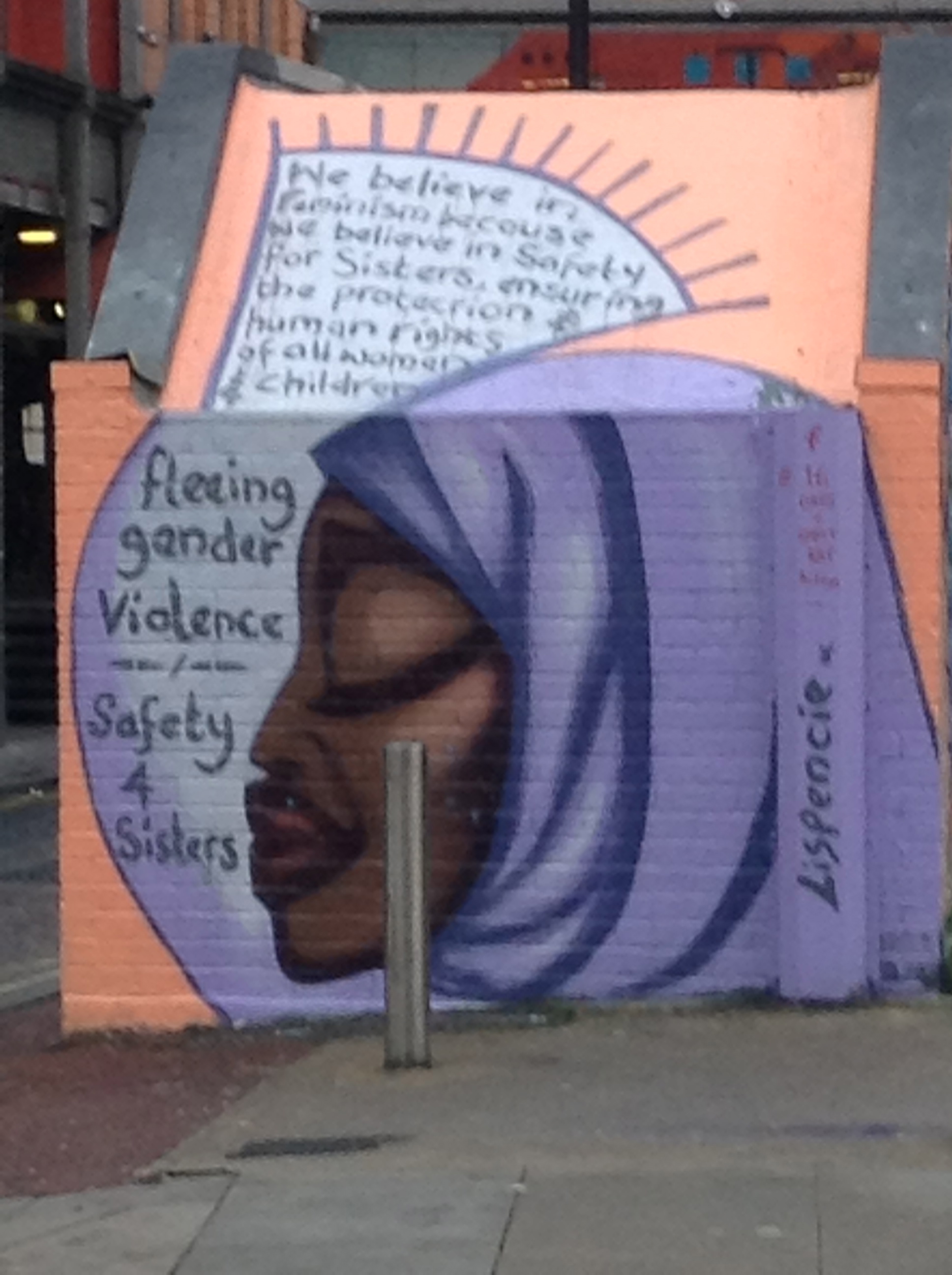
Suffragette, Slavery, and the Appropriation of Suffering

Controversy erupted recently over a photo shoot in which the stars of the movie, Suffragette, wore t-shirts that said, “I’d rather be a rebel than a slave.” A group of white women wearing a shirt with a message comparing themselves to slaves was a problem to begin with, but people familiar with the fact that southern defenders of slavery in the US are known as Rebels only made things worse.

Defenders of the movie, the photo shoot, and the quote said the outrage was based on a misunderstanding of the quote, which comes from a speech by the British suffragette, Emmeline Pankhurst, rallying women to free themselves from the oppression of patriarchy. In the United States, abolitionists and suffragettes were sometimes, though not nearly always, the same people. The comparison of slavery to women’s oppression was noted by many, including former slave Frederick Douglas, who wrote, “In respect to political rights, we hold woman to be justly entitled to all we claim for man. We go farther, and express our conviction that all political rights which it is expedient for man to exercise, it is equally so for women.”

In the UK, people are less sensitive to comments about slavery and rebels. Some have suggested that the UK did not have slaves and that the quote is therefore not offensive. Time Out London, which published the photos, said in a statement: “Time Out published the original feature online and in print in the UK a week ago. The context of the photoshoot and the feature were absolutely clear to readers who read the piece. It has been read by at least half a million people in the UK and we have received no complaints.”

The UK does have a history with slavery, though. Unlike the US, Britain did not have a large workforce of slaves, but that doesn’t mean the UK had no involvement in slavery. Slavery was abolished in the UK in 1833 by the Slavery Abolition Act, which ended slavery throughout the British Empire with the exception of territories under control of the East India Company, Ceylon, and the island of Saint Helena. The exceptions were eliminated in 1843. In the US, President Lincoln issued the Emancipation Proclamation in 1863.

Having been neither a woman nor a slave, I hesitate to comment on the controversy of the use of the Emmeline Pankhurst quote, but it turns out that philosopher Elizabeth Spelman made an insightful and relevant commentary on the issue in her 1997 book, Fruits of Sorrow: Framing Our Attention to Suffering. In the first place, she points out that phrases such as “women and minorities” excludes and ignores the existence of minority women. Comparisons to slavery are a case in point. She says,  “Consider the talk about women being treated like slaves. Whenever we talk that way we are not only making clear that the ‘women’ we’re referring to aren’t themselves slaves; we’re making it impossible to talk about how the women who weren’t slaves treated those who were.” When a white woman suffragette declared her preference for rebellion over slavery, was she honoring the suffering of slave women or, indeed, setting herself apart from them?

Drawing on the work of Jean Fagan Yellins, Spelman continues, “The female slave is made to disappear from view. Although presumably it was the female slave’s experience that originally was the focus of concern, the other women’s experiences were made the focus.” Somehow, white women made use of the suffering of slaves without experiencing the actual realities of slavery, even if the oppression of white women was intolerable, it was not an experience shared with actual slave women.

When this relationship between white suffragettes and slaves is exposed an analyzed, of course white women will want to deny their privilege and insist that they were only honoring their sisters. They can say this with great honesty, because they are not aware of their privileged status. Further, Spelman says, “The deeper privilege goes, the less self-conscious people are of the extent to which their being who they are, in their own eyes as well as the eyes of others, is dependent upon the exploitation or degradation or disadvantage of others.”

When privilege is pointed out, it makes us uncomfortable. As a result, our reaction is motivated by shame. Self-awareness is necessary to effect change, but it is also painful. Spelman says, “Seeing oneself as deeply disfigured by privilege, and desiring to do something about it, may be impossible without feeling shame.” The shame provokes a defensive reaction, but it can also help to facilitate healing and solidarity–in some cases, anyway.

With the Emmeline Pankhurst quote used by the magazine, we can see the defensive reaction. Many people defended the quote as being taken out of context, as being somehow separate from slavery because it was British, or being a victim of PC culture gone mad. In the end, though, the outrage at the use of the quote helped spark a conversation about the suffragette movement, Britain’s role in slavery, and sensitivity to women whose experiences lie outside the realm of so-called “white feminism.”

From Xu Mu to Donald Trump: Do We Need An Ethics Just For Women?

In the second GOP debate, candidates were asked an inconsequential question about what woman they would want to see on the $10 bill. Three mentioned family members who were caregivers and one mentioned Mother Theresa. Other candidates did mention women who were political leaders, but it is worth noting how difficult it is for some to imagine, even now, a great woman who is not caring for others. Rather, it is still hard for too many people to imagine that leading and fighting for justice and rights is a form of caring for women that is worthy of admiration.

The idea that women should be good, as women, but not in the same way that men might be good, is about as old as civilization. Men have placed women in an impossible bind forever. For striving to be the best person possible, they are often denounced, attacked, or even murdered for stepping above their station. In the seventh century BCE, Chinese poet and princess, Xu Mu found herself in a position where she felt she must defend her kingdom (Wei) against the Di people (see Barbara Bennett Peterson’s essay about dutiful daughters of ancient China here). She successfully rallied her brothers and friends from neighboring kingdoms to preserve their home.

A man in her position would simply luxuriate in the waves of honor and gratitude flowing over him, but Xu’s position was more complicated. She is remembered for her chinese poetaccomplishments, but she also faced the wrath of the men in her community. She recorded her mixed experiences and feeling in a poem, “Speeding Away”:

Harshly though you may judge me,
From my course I will not veer.
Compared to your limited vision,
Do I not see far and clear?

Harshly though you may judge me,
My steps you never can stay.
Compared to your limited vision,
Am I not wise in my way?

I’ve climbed the heights of A Qiu,
Gathered herbs on the slope alone.
All women are prone to sorrow,
Each follows a path of her own.
The people of Xu still blame me,
Such ignorance has never been known.

Out of necessity, she stepped out of the role of good wife, daughter, and mother to save her homeland only to be criticized, but she didn’t accept the criticism. She said, “O listen, ye lords and nobles, Blame not my stubbornness so,” but she was denied the opportunity to emerge as an unvarnished hero. If she had been a man, she would have been good, but she could not be considered a good woman without qualifications. Her society had two concepts of virtue: one for men, and one for women.

A couple of centuries later, Plato advocated for a single measure of virtue and goodness. He felt that the ideal form of the good was universal, so it wouldn’t make sense for some people to aim at one ideal and others at another ideal, as there can only be one ideal. Consequently, women and men should aim at the same ideal, and men, just by chance, seem to have an easier time getting close to it. In Plato’s Republic, women would be trained and educated in the manner of men in hopes of achieving their highest possibilities of human perfection. Women who succeeded in being the most like the best men would be the best women. Men who resembled women, on the other hand, were the worst of men. In Plato’s world, then, Xu Mu might be admired for embodying the virtues of men, but she may still be censured for failing in the virtues of womanhood.

Plato’s unusual conception of a single standard for virtue for men and women didn’t last long. His student, Aristotle, found insistence on a single standard for goodness unnatural and unfair. Men and women, being different, should strive for different ideals. A woman should be a good woman and a man should be a good man. To judge a woman on her ability to be like a “good man” would be as absurd as judging a musician on his ability to make good shoes. Women should do what is right and natural for them, he believed. Under Aristotle’s guidance, Xu Mu would do better to leave saving the kingdom to the men, who would be more rational and better prepared for war.

Those who feel women have different strengths than men will insist that they are not misogynistic. No, they love women for the things women do best. These men (and women) say that women have civilized men, make peace in families, and rear children for greatness. They love their mothers, wives, sisters, and daughters as they make it possible for men to achieve greatness in war, politics, business, science, and philosophy. For example. Ronald Reagan explained his high regard for women by saying, “If it wasn’t for women, us men would still be walking around in skin suits carrying clubs.”  The problem is that the things these men suppose women excel at doing are also denigrated by society precisely because women do them, which means that women are devalued as well. In the third century BCE, another Chinese poet, Fu Xuan, summed up the problem nicely:

How sad it is to be a woman!!
Nothing on earth is held so cheap.
Boys stand leaning at the door
Like Gods fallen out of Heaven.
Their hearts brave the Four Oceans,
The wind and dust of a thousand miles.
No one is glad when a girl is born:
By her the family sets no store.

By this measure, to be the best woman possible is still to be something inferior to even a mediocre man. Women may not attain the highest levels of virtue.

Upon reading the works of many men claiming that women are inferior at birth, Christine Pisan, wrote a rhetorical query to God in 1405 CE:

“Alas, God, why did You not let me be born in the world as a man, so that all my inclinations would be to serve You better, and so that I would not stray in anything and would be as perfect as a man is said to be? But since Your kindness has not been extended to me, then forgive my negligence in Your service, most fair Lord God, and may it not displease You, for the servant who receives fewer gifts from his lord is less obliged in his service.”

Trapped in a paradox, extreme virtue is demanded of women while it is simultaneously denied them. By asking God to resolve the paradox, Pisan brilliantly illustrates that it is men, not God, who created the paradox, for no God would be so irrational. The binary is not only absurd; it is impossible.

In 1694 CE, Mary Astell eschewed literary maneuvers and stated directly that men are to blame for the situation of women. In her Serious Proposal to the Ladies, she remarked, “That therefore Women are unprofitable to most, and a plague and dishonour to some Men is not much to be regretted on account of the Men, because ’tis the product of their own folly, in denying them the benefits of an ingenuous and liberal Education, the most effectual means to direct them into, and to secure their progress in the way of Vertue.”  She goes on to say, “For since God has given Women as well as Men intelligent Souls, why should they be forbidden to improve them?” Astell issued a call to arms for women. Many have responded, and continue to respond.

In the late 19th century, Mary Wollstonecraft repeated the call: “To account for, and excuse the tyranny of man, many ingenious arguments have been brought forward to prove, that the two sexes, in the acquirement of virtue, ought to aim at attaining a very different character: or, to speak explicitly, women are not allowed to have sufficient strength of mind to acquire what really deserves the name of virtue.”  Wollstonecraft argued that two standards of virtue only serve to cement the power of men over women. A single standard will liberate both.

Simply choosing between a singular or dual ethics does not resolve the problem of misogyny, masculine power, or the systematic devaluing of anything “feminine.” If we choose to embrace a single ethics, the default position is to embrace the ethics previously associated with “masculine” virtue. To do so, women must themselves then disparage “feminine” virtues, which will mean debasing the activities traditionally associated with women. Thus, both women and men engaged in such pursuits are permanent held in reduced stature.

On the other hand, to embrace a dual system of ethics is to preserve the status quo. The male system of ethics continues to be the good and noble ethics while the female ethics is valued only for its contributions to maintaining the power and worth of male activities.

A single ethics that values all virtues and activities that are, in fact, valuable demands a complete deconstruction of gender and power so that it can be replaced with a non-binary system that embraces and venerates all activities that aid human flourishing. If nurturing children is a good, then it is good for both men and women. Such a system can have no concept of “women’s work” or “men’s work.” The idea that activities or dispositions (caring, assertive, protective, sensitive) are “masculine” or “feminine” must become a foreign idea. This will require radical resistance. Xu Mu and others like her began this battle nearly 3,000 years ago. After watching the second GOP debate, I believe it may take another 3,000 years to finish the war.

Medicare at 50: Our Moral Imperative

Last year, on the 49th anniversary of Medicare, I wrote a post advocating the expansion of Medicare to ensure that everyone in the United States can have access to basic healthcare. In the past year, I have read and heard many arguments against the expansion of Medicare and, in fact, single-payer systems in general. As I read the arguments, I realize that in a sense “Medicare for All” and “single-payer” have become a shorthand way of saying we need to guarantee “universal access to healthcare,” but I still think Medicare for All is the way to go in the United States.

I happily admit, though, that my commitment is to universal access to healthcare, not Medicare. The first step, in my opinion, is to declare that we will provide access to medicare for allhealthcare to all United States citizens. Take this simple idea, and make it law: We will provide healthcare to every citizen of the United States. Once that law is passed, we can have extended debates about whether Medicare can fulfill the purpose of guaranteeing that all citizens will have access to healthcare (my repetition is intentional).

Here are some of the objections I’ve heard and read to expanding Medicare along with my replies:

I don’t want to pay for healthcare for people who are too lazy to work.

Many people I talk to are extremely optimistic about their ability to pay for their healthcare in the case of extreme illness or injury. The fact that you’ve made it so far only means you’ve been lucky, not self-sufficient. Mary Brown, who sued the government over the Affordable Care Act because she didn’t want to purchase insurance, went bankrupt and was unable to pay her bills. In response to her own bankruptcy, Brown reportedly said, “”I believe that anyone has unforeseen things that happen to them that are beyond their control.”  Yes, and the Affordable Care Act was designed to reduce the impact of unforeseen illness and injury. Unlike Mary Brown, many people who become medically bankrupt had insurance but weren’t able to cover their medical bills, anyway. A study in 2007 found that three-fourths of people who were medially bankrupt had insurance.  A study by NerdWallet Health found in 2013 that “Despite having year-round insurance coverage, 10 million insured Americans ages 19-64 will face bills they are unable to pay.”

For people who do have insurance, most get it through their employers. Too many people seem to forget that when they face unforeseen illness or injury, they will also be unable to work and are likely to lose their employer-provided insurance. If not immediately, it will happen sometime further down the road. Whether the road is long or short, it leads to bankruptcy. While some are rich enough to be impervious to mounting medical debt, most of us are not. A few hundred thousand dollars may sound like a safe cushion against medical disaster, but many life-saving treatments exceed that amount quickly. Selling your house and other assets to pay your medical bills may not be a solution. In fact it probably is not a solution.

The fact is that supporting a national program to guarantee access to healthcare free from the risk of burdensome medical debt is not something you should do only for other people. It is something you should do for yourself. And it is something we should do for our country.

As a nation, we share many burdens: national defense, national safety, public health, personal security. Like infrastructure and security, we are not talking about items we can choose to forgo in leaner times. These are basic human needs. Any society that does not meet the basic needs of its citizens will falter. If we can share the cost of providing a strong military, food inspectors, fire fighters, and police, we can share the cost of providing health services. The financial life you save may be your own.

Most countries don’t have a true single-payer system.

The argument here is that many countries that do guarantee universal access to healthcare do not use a “true” single-payer system. I am willing to concede that even Medicare for All might technically require the use of more than one payer. What is important, really, is that the payers are not invested in fleecing their clients, which often seems to be the case with for-profit insurance companies. In fact, if we had a single for-profit insurance monopoly, we might find our processes somewhat more efficient but not beneficial for consumers, so it matters who the single payer is as well. Just to repeat: we must have a system that guarantees access to healthcare without the risk of bankruptcy.

Medicare is fraught with fraud and abuse.

No one can deny that fraud and abuse exist within the current Medicare system. We need greater transparency, oversight, and regulation of the system and of the providers. Also, Medicare must have the ability to negotiate prices, unlike the disastrous Medicare Part D that currently exists for prescription drugs.

Corporations will game the system.

It is true that for-profit providers, whether they are pharmaceutical companies, for-profit hospitals, biotechnology companies, medical equipment suppliers or food vendors, will strive to earn as much profit as is humanly possible. This is why we need a system that empowers taxpayers to hold bad actors accountable and demand transparency regarding pricing and profit. Corporations will serve the common good only when common people demand that they do. Fatalism is an excuse to avoid the hard work of diligence.

We need price controls.

Again, simply removing all but one payer will not, on its own, lower prices. If Medicare simply sent checks to providers for whatever charges they submitted, the United States would continue to have the costliest healthcare system in the world. Medicare must have the ability to negotiate prices and set limits on unchecked profits.

We must limit unnecessary tests and treatments.

In a pay-for-service system, hospitals, labs, equipment manufacturers, and others make money every time someone is tested or treated for anything at all. More and more studies are finding that many tests lead to unnecessary treatment, waste money, and (even worse) cause more injury and death than they prevent. Unfortunately, limiting the number of tests and treatments available to patients is likely to be perceived as (shriek) rationing.

With our current system, we trust insurance companies to refuse payments for useless or harmful tests and treatments, but we know this does not always happen. When it does, clients fear they are being denied necessary tests and treatments. They fear this largely because it is sometimes true. Whether Medicare is expanded or not, we need better ways to evaluate what tests and treatments are beneficial, and we need better ways of educating patients on what is and is not beneficial.

Movements toward paying providers for results, not services, may reduce unnecessary and harmful services greatly. It may also force patients to become more responsible for their own health.

Finally

The only real imperative here is that we, as a nation, must decide whether we will provide access to healthcare for all our citizens. Once we agree that we will, we can begin to work out the most efficient and cost-effective means for achieving our goals. Almost no one in the United States is immune from the possibility of medical disaster and bankruptcy. This is a matter of caring for our fellow citizens, but it is also a matter of caring for ourselves.

On the 50th anniversary of Medicare, take a stand for healthcare justice.

Slaying monsters: Ethics as a Matter of Opinion

I have the distinct pleasure of teaching ethics to many students who, frankly, do not believe the study of ethics is of any benefit to them or anyone else. From time to time, usually near the beginning of the semester, a student will express frustration that a required ethics class seems a colossal waste of time, as ethics is “just a matter of opinion.” People have to make up their own minds about what is right and wrong, and one opinion is as valid as another.

I challenge this as most ethics teachers challenge it: “So,” I say, “If someone were to kill someone, no one has any moral authority to challenge that person’s opinion that such behavior is perfectly moral.” Students will often then say, “Well, it depends.” I will then assert that whatever it depends on is the fulcrum of the student’s own moral theory—it is a creepcore moral value. With a little engagement, we usually get around to a fairly simple statement of what I do take to be a near universal moral value. It is okay for people to have their own moral opinions and to make their own decisions about their behavior so long as they are not hurting anyone.

Of course, we do hurt people. We execute people. We put people in jail. We take scissors away from running toddlers who would rather play with the scissors. We hurt people in many ways. Most students will agree that it is acceptable to hurt someone with some greater good in mind—or, for some students, it is acceptable to hurt someone as punishment. It hurts to give a child a vaccination, but the purpose is to protect the child and society from disease. It hurts to kill someone who has broken into your home to murder you, but killing the guilty to protect the innocent is considered a good by almost everyone, even as we acknowledge pacifism and non-violent resistance. This being the case, most students will agree that it is wrong to harm someone who is innocent, unless that harm is aimed at a greater good (e.g., I may violently knock someone to the ground to prevent her from falling thousands of feet to her death or give a child a vaccination to protect her from disease).

When we accept that it is wrong, generally, to hurt innocent people, we are left with two questions: 1. What constitutes harm? 2. What is a person? The first question seems easy until we try to answer it. When some information will be extremely painful to someone (say, some embarrassing photos and personal information of someone are posted in an office he is completely unaware of unlikely to ever know about), is it more harmful to tell the truth or to keep a secret? Is failing to prevent a harm the same, morally, as harming someone? Many moral dilemmas revolve around just such questions. Even with these difficulties, though, I don’t think the question of harm is what derails morality. Reasonable people with good intentions can have productive discussions about harm, even if they don’t always arrive at consensus on what harms are or are not justified.

It is the second question that effectively ends progress of moral conversation. We want to say everyone deserves equal protection from harm, but we don’t always agree on who “everyone” is. The founders of the United States purportedly believed “all men” are created equal. Women, slaves, other minorities, and children did not fall under the umbrella of “all men” in either policy or practice. Everyone should be treated equally under the law, but some of us have a fairly narrow view of who “everyone” is.

Some people want only to protect rational beings, which would seem to indicate adult humans, while others want to protect, seemingly, all living things. I spend perhaps too much time trying to understand how people who seem to want to be moral can justify slavery, torture, sexual abuse, or even genocide. In most cases, the people guilty of the horrendous crimes are not amoral; they simply have a morality that does not recognize the rights of their victims. By one way or another, they have come to view their victims as less than human.

Thus, police may view those suspected of crimes as being beneath them and undeserving of respect and thoroughly devoid of dignity. People may view those of other races as being subhuman or animalistic. In the same way, too many people compare sexual minorities with animal behavior or will even refer to “those people” as animals. Women are often viewed, depicted and described as animals or even inanimate objects. The poor, too, are often described as vermin or even rubbish. People often deny the worth and dignity of many classes of people. Though we all come from the same creator (your choice who the creator is: evolution, God, spirits, or whatever), some of us manage to ignore the worth of others in our community.

Religious Friends, Quakers, have the idea that we should always recognize “that of God in everyone.” Even if you don’t believe in God, this idea is a powerful way to examine what others deserve our respect. We all share the same ancestors. We all share the same emotions. None of us is perfect, and no one is without worth. Even for those who have done the worst, dictators, terrorist, and so on, we must remember that they, too, are made of the same flesh.

It is through empathy and compassion that we can better understand our enemies. I am not saying there can never be a justification for punishment or even some defensive acts of violence, but I am saying these acts must be carried out with the full recognition of our own flaws and the humanity of our enemies, opponents, and, yes, friends.

You are not perfect. Try to love another imperfect person today. And tomorrow.

Why I Am Not Your Ally

In response to injustice against members of various communities, those affected rise up, thank goodness, against the injustice accompanied by their allies from outside the community. Thus, the black community has white allies, the gay community has straight allies, women have male allies, and so on. I want to join all these communities in the struggle for justice, but I’ve never felt any connection with the word “ally.” Perhaps I over think things (I’ve certainly been told I do), and I can see why some people would see an “alliance” as a good thing, but I really think the idea of an ally preserves the concept of division and otherness.

The source of most oppression comes from this concept of otherness. Simone de Beauvoir told us, “No group ever sets itself up as the One without at once setting up the Other over against itself.” Thus, she says, “In small-town eyes all persons not belonging to the village are ‘strangers’ and suspect; to the native of a country all who inhabit other countries are ‘foreigners’; Jews are ‘different’ for the anti-Semite, Negroes are ‘inferior’ for American racists, aborigines are ‘natives’ for colonists, proletarians are the ‘lower class’ for the privileged.” It is the distinction between One and Other that is the source of the problem. If the One becomes an advocate for the Other, does this change the balance of power? I argue that it does not. The ally speaks from a position of power on behalf of the less fortunate, often with the expectation that the weaker party will feel and exhibit an overflowing gratitude. At least, that is how it feels to me.

All the same, we can’t ignore our differences from others. It is important to preserve cultural distinctions, for example. Only the Deaf community fully understands the special problems faced by deaf people. Only the Native American community can understand injustices against Native Americans. And so on. What unites us in our struggle, though, is that we all are able to understand what injustice is. Those of us who are outraged, disgusted, and revolted by injustice, will react with those feelings every time we see it, regardless of the specific circumstances or characteristics of the victim. At least this is what I hope. When I react to injustice, I don’t do it because I feel someone deserves my sympathy or respect. I do it because I am offended by injustice. The specific qualities of the victim are not the source of my outrage.

This isn’t to say the specific qualities of the victim are not relevant, especially regarding discussions of how to understand and address the injustice. We need to have conversations so that we can understand each other. As Kwame Athony Appiah put it in his book, Cosmopolitanism, “We take seriously the value not just of human life but of particular human lives, which means taking an interest in the practices and beliefs that lend them significance.” We must also understand the experiences of others. Through conversation, stories, art, music and language we can share experiences and enhance our ability to imagine the lives of others. By understanding the experiences of others, we are better able to understand that their experiences are morally inexcusable.

Affirming justice requires us to see the common humanity we have with others. Those who harbor feelings of innate superiority are easily enticed to barbarous behavior. David Hume notes that Europeans had such feelings of superiority over natives in America that it “made us throw off all restraints of justice, and even humanity, in our treatment of them.” He goes on to describe similar treatment of women, owing to the fact that men “have in all countries bodily force sufficient to maintain this severe tyranny.” Those who are able to disregard the humanity of others and have the power to force them in to submission feel entitled to exercise their power. It is my contention that the person who does not carry feelings of entitlement will be sickened by the abuse of others. When we recognize our shared experiences with others, feelings of entitlement dissolve. When we feel an innate superiority, entitlement is cemented in our psyche.

The people who are most able to recognize their common humanity are those who have experienced injustice or at least recognized the possibility that they might. I don’t mean those threatened by the loss of their own power or privilege but those who recognize that we are all inferior in someone else’s eyes. The rage against injustice against other races or citizens in other countries is a rage against injustice that could befall anyone at any time. Often marginalized and oppressed groups recognize the oppression of other groups before the privileged can see. Declaring that someone is privileged, however, has its own hazards. A person’s oppression may not be readily apparent on his or her face or skin or other aspects of personal appearance. Religious, sexual, gender, and cultural differences are not always visible on the skin, but these differences often lead to extreme oppression and violence.

Occasionally, people are unable, flawed as we all are, to recognize their common humanity allieseven with those with whom they have no discernible differences. Consider the bitter conflict between the Hutu and the Tutsi in Rwanda. In a 1996 interview with Charlayne Hunter Gault, Professor George Izangola described the lack of differences between the two groups: “In Rwanda, the Tutsi and the Hutu are the same people. They are all people–large grouping or communities which go from seven regions of Cameroon to Uganda–all the way to South Africa, in the same culture. People used to be Tutsi or Hutu, depending on the proximity to the king. If you were close to the king, you owned wealth, you owned a lot of cattle, you are a Tutsi. If you are far away from the king, you are a cultivator, you don’t own much cattle, you are a Hutu.” (I’ve taken this quote from PBS here.)

If some of us can deny the humanity of those who look almost exactly like us, then “otherness” is a phenomenon that goes beyond race and gender. We either recognize that we are part of humanity or we do not. One way leads to freedom and the other to fascism. In “The Ethics of Ambiguity,” Simone de Beauvoir declares that we are each in a subjective struggle for freedom but that we are defined in our relationship to others. Our struggle for our freedom entails a will for the freedom of others. She says the activist “exists only by transcending himself, and his freedom can be achieved only through the freedom of others. He justifies his existence by a movement which, like freedom, springs from his heart but which leads outside of him.”

For Beauvoir’s activist, the constant push for freedom is a push for humanity. In this sense, an injustice anywhere is, indeed, a threat to justice everywhere, as the saying goes. The existence of injustice itself destroys the condition of freedom. Resistance is, she says, the annihilation of injustice. In an apparent paradox, I struggle alone but alongside and in relation to others. As your struggle is yours alone, my struggle is mine alone. Rather than acting as an ally seeking justice on your behalf, we must work together to secure freedom on our own account, which requires freedom for all.

Your health choked by the invisible hand of the market

Sometimes the invisible hand of the markets is all too apparent as it clutches us by the neck and strangles us slowly and painfully. If you are a typical adult American, you are likely to have at least one prescription for a drug indefinitely, either until you die or another drug is developed to replace it.

In the world of libertarian fantasy, pharmaceutical companies would compete to develop drugs we need to cure diseases that plague us. Hoping to sell us their products, they would race to develop effective and inexpensive drugs that consumers would rush to purchase. Unfortunately, those profits would be short-lived. People would buy the drugs, get well, and go about their business drug-free and non-contagious. Companies can make some money that way for sure, but it is much more lucrative to develop drugs that do not cure anyone but simply maintain their health.

This is why we have so many drugs for cholesterol, blood pressure, acid reflux, and other chronic conditions with fewer drugs aimed at eliminating disease, and even fewer aimed at curing (or even treating) diseases that affect those too poor to pay for expensive remedies. The fact that there is any treatment, even in early experimental drug trials, for Ebola is thanks to government funding of research. Left to markets alone, the diseases that kill the most people in the world would be completely ignored by drug companies.

Some diseases, such as Type II Diabetes, affect poor people, but drug companies spend quite a bit of time developing treatments for them. This, of course, is because enough people receive insurance payments from private insurance or Medicare and Medicaid to make treating them worthwhile. Almost 27 percent of Medicare beneficiaries 65 or older have diabetes, accounting for 32 percent of Medicare spending.  in 2002, Medicaid expenditures for people 20 and over with diabetes were estimated at more than $18 billion.

Of course, diabetes also affects people who are relatively affluent by global standards. In fact, it is considered a disease of babymotherdeathoverconsumption notwithstanding the fact that many who suffer from diabetes in the US are less affluent. Thus, it is extremely profitable for companies to develop products and services for diabetics in the US where their profits are underwritten by taxpayers. Diseases that primarily affect impoverished people in poor countries get much less attention.

It would seem likely that donations from individuals could fund research and development into alleviating disease. Indeed, the ALS ice bucket challenge raised more than $100 million as of this writing for research and treatment of ALS. But this again, leaves the allocation of resources to the mercy of marketing campaigns. ALS is a cruel disease, and it will only be a blessing if a cure can be found, but diseases that affect primarily impoverished individuals (e.g., malaria, antimicrobial resistance, trachoma) in the world are still waiting for a viral marketing campaign to draw attention to the millions that die from them. Market-based approaches drive money to those with the most influence.

In order to reduce the burden of diseases that affect the most people, we must provide research funds that are distributed where they will be most effective, rather than where the market funnels them. We need research centers funded by money offered with no conditions with the charge only to reduce mortality and relieve suffering. Such centers could be funded by government money or by individual contributions, but funding must come with no strings attached other than a demand for transparency from researchers as to how the money is used and what diseases are being treated. Some have offered solutions that would rely on industry to conduct research and develop products to alleviate suffering, but industry cannot be trusted with this task. Industry will always develop products to maximize profits, not minimize suffering.

The so-called “rugged individualists” in our society would argue that each person should have the healthcare he or she can afford, as income is a reliable measure of a person’s worth. Unfortunately, disease doesn’t attack people on the basis of merit. Honest and hard-working individuals can and do fall ill or become injured. Some are surprised by their turn of fortune. It is easier for a wealthy person to become poor than it is for a poor person to become wealthy, and disease and injury are great conveyors to the lower classes. Some, of course, are rich enough to be indifferent to the cost of healthcare or even long-term care. Even without working at all, these individuals will be housed, fed and treated.

People who work for their income, though, even in highly paid professions, are vulnerable to losing everything to healthcare costs. The “excellent” health insurance many people rely on is tied to employment and employment is tied to health. The unlucky ones who become ill lose both in a heartbeat. Bad luck isn’t a matter of bad choices or immorality; it is only a matter of chance. Libertarians argue, basically, that people should be responsible for the choices they’ve made in life, but libertarians also feel the government should protect people from events and circumstances out of their control. Thus, libertarians support the use of government funds to provide courts, police, and standing armies to protect the security of citizens.

The risk of disease and injury threatens us all. The question is whether we, as a society, should take responsibility for protecting all our citizens from this threat. If we don’t do this through government action, we must do it through collective action. Single-payer healthcare, such as all other developed nations have, is the most obvious solution to making citizens secure. Other solutions exist, and can be considered, but no one can prepare for catastrophe alone—collaboration is required.

We must provide funding for both medical research and healthcare. I am not asking you to provide healthcare for someone else. I am asking you to share the burden of providing healthcare for yourself. Sure, there is the chance you will never need it, but your chances are no better than anyone else’s. If we are not all secure, we are all insecure, we are at risk of being choked by the invisible hand. If we are insecure, we are not free.


Ebola and the ethics of international drug testing

Ebola has been around for nearly 40 years now, and until recently the public was unaware of any available treatments or treatments in development for the disease. In fact, there is no market incentive for pharmaceutical companies to develop treatments as most of its victims are too poor to buy medicines. If and when Ebola spreads to more affluent parts of the world, of course, pharmaceutical companies will adjust their research and development strategies.

As market incentives for development of treatments do not exist, it falls to governments to fund research into possible treatments and vaccines. As Marie-Paule Kieny, assistant director-general of the World Health Organization (WHO), pointed out, “If it hadn’t been for the investment of a few governments in the development of these drugs, we would be nowhere.” Much of the funding for research has come from the United States, not from humanitarian concerns for Africans, but for domestic concerns. According to a Globe and Mail article by Geoffrey York, “most of the research on Ebola treatments has been financed by the U.S. government, often because of fears that the Ebola virus could be used aesculab-stabas a form of bioterrorism.” Be that as it may, it is a relief to know that someone is working on treatment and prevention.

As the disease has occurred in Africa, you might expect that research on it should also occur in Africa with robust drug trials being conducted in an ongoing basis, Bioethicist Arthur Caplan  says it is unreasonable to expect the research to happen in Africa. He wrote, “Privileged humans were always going to be the first ones to try it. ZMapp requires a lot of refrigeration and careful handling, plus close monitoring by experienced doctors and scientists—better to try it at a big urban hospital than in rural West Africa, where no such infrastructure exists.” ZMapp is the drug given to the Americans who contracted Ebola in Africa before being flown back to the US for treatment.

It might be possible for pharmaceutical companies to build such infrastructure, but Caplan encapsulates the real reason research does not happen in Africa nicely: “Drugs based on monoclonal antibodies usually cost a lot—at least tens of thousands of dollars. This is obviously far more than poor people in poor nations can afford to pay; and a tiny company won’t enthusiastically give away its small supply of drug for free.” Enthusiastically give away? No, they won’t even develop the drug in the first place.

Now that an experimental treatment (ZMapp) does exist, should it be tested on Africans? Bioethicist George Annas says, “If the drugs we are currently working on have been shown to be reasonably safe, and if there is realistic and robust African review and individual informed, voluntary consent, use of American-developed drugs in Africa could be justified.” Annas is here emphasizing the protection of possible African research participants rather than explaining why only the privileged should receive the drug, and he has good reason.

It isn’t as though the lack of infrastructure in Africa has prevented drug trials from taking place there in the past as you might imagine from the debate over Ebola drugs. In fact, testing has raised serious issues of exploitation in the past as drugs were tested on vulnerable populations with no intention of ever providing those same populations with any treatments that might be developed. In 1994, the HIV drug, AZT (zidovudine) was found (in a study known as AIDS Clinical Trials Group 076)  to prevent transmission from HIV-positive mothers to their infants. The study was considered important in the development of drugs to treat AIDS, but there were no plans to provide AZT to the communities where it was tested once the clinical trials concluded. Research subjects in Africa bore the risks associated with taking experimental medications but would not see the benefits of the medications developed.

As there is no market incentive for pharmaceutical companies to develop treatments while protecting research subjects in vulnerable populations, it is up to governments to help promote treatments for unprofitable diseases. This has obviously happened to an extent., but we could, and should, do more. Philosopher Thomas Pogge has initiated a plan to help improve the situation. He has proposed a Health Impact Fund  that would provide a sort of artificial market incentive for companies to develop otherwise unprofitable treatments. Under the plan, governments would contribute to a fund that would then be distributed to pharmaceutical companies based on their ability to develop drugs that would have the greatest health impact. In order to receive payments from the HIF, companies would agree to provide treatments at cost anywhere in the world. I don’t know whether the Health Impact Fund will provide a solution to treating diseases that primarily affect the poor, but it certainly represents the kind of thinking required to address these serious issues.

If we are not motivated by the suffering of others in the world, and it appears many in affluent countries are not, we may do well to recognize that diseases do spread beyond all borders. Diseases that do not affect us today may well affect us tomorrow. The so-called “free” market is obviously not the solution, so we will do well to consider other options.

Our Bodies, Ourselves and the birth of bioethics

The first works of academic bioethics I read were by notables such as Peter Singer, James Rachels, and Bonnie Steinbock, but that is not where my interest in bioethics actually began. In the 1980s, I ran across the book, Our Bodies, Ourselves, and I was immediately captivated by the book and the movement it represented, even if I wasn’t part of the particular movement.

The book began as an outgrowth of the feminist movement when 12 women met in 1969 to discuss their experiences with doctors. They began compiling and disseminating their stories and information to empower women to take charge of their own healthcare decisions. Bioethics as a professional field developed in the 1970s, but the authors of Our Bodies, Ourselves were ahead of professional bioethicists by a few years. In 1970, these authors released a booklet titled “Women and Their Bodies.” While professional bioethicists focused on the role of autonomy in healthcare, these women were creating autonomy by giving women information and the courage to take charge of their own healthcare. You can read more about the history here.

At the time these women met, abortion was illegal and most doctors were male. As the authors explained in the preface to the first edition of the book, “we wanted to do something about those doctors who were condescending, paternalistic, judgmental and noninformative.” To combat the attitudes they found common in doctors, they presented information on birth control, abortion, menstruation, masturbation, and sexuality in frank and shame-free language. As a outcome of the approach, they said, “Our image of ourselves is on a firmer base, we can be better friends and better lovers, better people, more self-confident, more autonomous, stronger and more whole.”

Our Bodies, Ourselves, the book, continues to be published (now in more than two-dozen languages), and the organization, Our Bodies Ourselves (OBOS), continues as a nonprofit organization promulgating information on girls’ and women’s health and sexuality. Their efforts now extend globally through the Our Bodies Ourselves Global Initiative (OBOGI).

These women approached bioethics from the ground up and changed the world.

This is how I feel bioethics should be conducted for the greatest impact. Patients, ideally, should drive the focus of bioethics and inform both ethicists and healthcare providers of what issues are important. The only way for this to happen is for patients to tell their stories of how they experienced healthcare, medicine, illness, and even death.

To that end, I am inviting patients to submit their own stories of illness and medicine to Ethics Beyond Compliance. If you would like to submit a story related to your experience of illness (either as a patient or as a caregiver) or grief, please send it to me. I will have a story coming up in the next few days, but I hope to make it a regular feature of the blog.

See also: O is for Our Bodies, Ourselves

Why men don’t speak out against sexism and misogyny

When we feel ashamed or judged, we have several possible ways of responding. One IMG_0516method of dealing with shame is to defend yourself vigorously, to deny anything is wrong, and to attack those who might think differently. We can imagine the loud protests of Hamlet’s mother, though perhaps Hamlet’s attack on his mother is equally revealing. A second method, which is my preferred method, is to try to suppress it, hide it, and pretend it does not exist, and I think I have plenty of company with millions of people struggling with feelings of inadequacy, guilt, and a myriad of shortcomings. This kind of shame destroys you from the inside out. The third and most difficult method of dealing with shame is to acknowledge it, confront it, and try to resolve it in some way. When we meet individuals who can do this, we admire them, praise them, and exalt them, which is as it should be. Think of a former member of the KKK who becomes a civil rights leader, for example.

In the aftermath of Elliot Rodgers’ mass killing, pundits, analysts, feminists, psychologists, and just about everyone else has jumped to understand and explain what may cause someone to want to kill with such intensity and drive. It appears that Rodgers dealt with feelings of deep shame and inadequacy because he felt he failed as a man because he couldn’t convince women to have sex with him. Many men, even those who have had their share of sexual encounters, share his shame, but fewer question the assumptions that create that shame. Men are expected to be on a constant mission to prove themselves through sexual conquests, and most men internalize this to one degree or another in the same way that women internalize attitudes toward body image.

It isn’t surprising, then, that many men reacted defensively to discussions of sexist attitudes and their dire consequences. Who is going to say, “I see now that I’ve bought into a dangerous belief system. I see that my way of thinking leads to mass murder.”? Not many, which might explain the emotional and unrelated defenses of Glenn Beck, Seth Rogen, and all the men who reacted negatively to #yesallwomen. Beck went on a long tirade against the idea that sexual assault and harassment is prevalent and suggested that people are calling normal, consensual sex rape. Rogen responded to Ann Hornaday’s critique of media that depicts women as trophies by tweeting, ““How dare you imply that me getting girls in movies caused a lunatic to go on a rampage.”

These men want to make clear that they are not part of the problem. They recognize that their attitudes and maybe even their actions are now being criticized as part of the problem, and they are saying, “Hey, don’t point the finger at me.” They may also realize they have internalized the values that oppress and torture men. We may want to respond to #yesallwomen with #notallmen, but the fact is that all men, at least in my culture, are familiar with the beliefs and attitudes that shame men for “purity” and women for “sexual prowess.” We feel it deep in our bones, and it makes us uncomfortable.

In the next wave, many women wonder why more “enlightened” men don’t speak up and stand with them. To be fair, many men have shown the courage to do this, but doing so requires us all to look inside and examine what we may prefer to hide and suppress. You don’t have to be a rapist or a murderer to recognize common feelings or assumptions you may have or may have once had, and it can create a kind of soul-burning shame.

Few tasks in life are as difficult as confronting our own shame. The attitudes and beliefs that define us as men and women touch us at the core of our being. A thoughtful, honest, complex, and courageous discussion of how to liberate and protect men and women will be lengthy and arduous, but a better world is possible.

PS: And let’s have a discussion about access to guns as well.

For more on shame, see the work of Brené Brown.


Horton’s Taxonomy of Racial Prejudice

It seems we keep having people make racist remarks and then proclaim, defensively, that they are not racists. Some people are so hostile that their claims of innocence are both laughable and infuriating, but others seem genuinely bemused by the accusation that they are racist. It doesn’t seem possible that anyone could be so clueless, their critics think, that their attitudes would not be obvious to them. In other cases, people strive with everything they have against being racist, only to find to their dismay and horror that they have unconscious racial biases.

In order to sort things out, I think we need to recognize a few categories of racism:

1. Overt racial hostility. In this category we have white supremacists (or other kinds of supremacists, even, depending on your location and circumstances). People in this category believe other races are inferior and will not apologize for saying so. We can renounce them, but we aren’t likely to shame them, as they are quite self-righteous in their belief in their own superiority (leaving their latent fears and anxieties aside for the moment).

2. Racial Prejudice. Some people say they don’t hate anyone or want anyone harmed, but they just happen to believe it is a brute fact that people from different races are different and have different abilities and preferences. People in this category can be the most confounding, as they might say things that are outlandish to the rest of us and then become extremely offended that anyone could possibly accuse them of racism. “I don’t hate such and such people, but they sure hate hard work. God love ‘em.”

3. Racial insensitivity. Sometimes people genuinely don’t mean any harm at all but have no idea how their comments may hurt others. Assuming a person of a particular race enjoys a certain kind of music, dance, food, or whatever may seem completely reasonable to you while it reduces that person to a broad stereotype. Even if the person does happen to like that music or food, he or she may resent you making any assumptions about their taste based merely on race or ethnicity.

4. Racial privilege. A member of my family once said he couldn’t understand why certain groups were always complaining about police harassment. He mentioned that he had many experiences with the police and he had always been treated with respect and courtesy. It didn’t occur to him that his skin color, sexual orientation, and socioeconomic class had anything to do with his treatment. That certain groups are targeted for mistreatment seemed inconceivable to him because he never had to experience what others endure regularly. This is the nature of racial privilege. (Yes, many kinds of privilege exist, but they aren’t relevant to this discussion.)

5. Unconscious and undesired racial bias. Finally, we all have biases without realizing it. When people take psychological tests (you can take one here) to see what biases they have, they may be chagrined to find they are biased against others without wanting to, but some of us are even surprised to find we hold implicit biases against our own social groups. Even those who are aware of no bias whatsoever find that some biases are so deeply entrenched that they are difficult to detect. Ironically, those with the least ill feelings toward other races are, in my experience, more aware of implicit bias. Confront an obvious racist about overt racial attitudes, and he or she will often declare, loudly, that he or she is completely indifferent to race. In my experience, those who are most committed to ending racial prejudice are the ones who are also most willing to examine their own implicit biases. Such is life.