Grief and the problem of meaning making

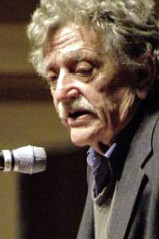
Kurt_Vonnegut_at_CWRU
Kurt_Vonnegut_at_CWRU (Photo credit: david_terrar)

I’ve been reading Kurt Vonnegut again. It is a bad habit I started as a teenager. When I began reading Vonnegut, I was a classic example of a depressed teenager, or at least that was how I saw myself.

Looking back, I realized I had many reasons to be sad. Extremely sad, even. A friend had died in a motorcycle accident when a car pulled in front of him in our own neighborhood, and then my uncle, who was 25 years old, died in a fire that consumed the mobile home he was living in. Of course, a few other bad things happened, too, and the world just seemed a little crazy to me, not fair at all.

My confusion was confounded by the fact that I would often hear family members ask one another, “Do you think someone is trying to tell you something?” They searched each devastating event for a message from God. If something bad happened, it was because we had done something wrong. At church, I learned that all the pain, all the trials, and all the trauma was part of God’s plan, even if no mortal could make heads nor tails out of the plan. I hadn’t read Kierkegaard yet, but I was told to take a “leap of faith,” and then I was thrown off a cliff of faith.

Søren Kierkegaard (Copenhague)
Søren Kierkegaard (Copenhague) (Photo credit: dalbera)

So, around that time, I read about Kurt Vonnegut’s unlucky sister. In the prologue to Slapstick, he told of how while his sister, Alice, was dying of cancer, her husband, who was to take care of their children after her death, died on “the only train in American railroading history to hurl itself off an open drawbridge.” It was bad luck—bad enough to make you feel a little depressed.

But Vonnegut always made me feel better about things. He said, “Since Alice had never received any religious instruction, and since she had led a blameless life, she never thought of her awful luck as being anything but accidents in a very busy place.” Although I have received prodigious religious instruction and led a life full of blame, that one line has gotten me though many dark moments.

Over the years, I’ve heard many people tell me that bad things were part of some tortuous plan by some deity or other, I’ve heard that children are only on earth as a “loan” from God, and I’ve heard that God won’t give us more than we can handle. It seems to me that people routinely get more than they can handle. Many people die from stress-related illness or suicide, brought about by despair and a massive inability to cope with life’s tribulations.

Ah, but the people who didn’t survive just didn’t have enough faith to get by. The message I got from this was: “Be strong—or God may kill you.” If I had no faith in the purely accidental nature of bad luck that I learned from the Vonneguts, I am not sure I could have survived my life, which really only has the normal amount of sorrow and trauma. I haven’t been spectacularly unlucky, even by first-world standards.

Thanks to some of the interpretations I have heard of the meaning of traumatic events, I get a little nervous when anyone starts talking about making meaning of suffering. I’m quite happy to believe that suffering is just one of the vagaries of an existence fraught with peril. According to a paper by psychologist Robert Neimeyer and his coauthors, people have an intense need to “make meaning” after an extreme event disrupts their life narrative. Through a process of making meaning, individuals are able to restore a coherent narrative of their lives.

Part of the problem, it seems, is that most people believe the world has a certain moral order, and that people who are good will be rewarded with positive outcomes. So, when bad things happen, we will surely ask, “Why me?” This is a question Alice Vonnegut never asked herself, according to her brother, anyway. The horrible luck she had did not interrupt her narrative because her narrative was one of randomness and accidental events.

Regardless of what narrative one tells regarding the moral order of the universe, many people do see their own moral or spiritual growth as a result of suffering. Indeed, when we meet young people who are self-satisfied and callous, we often think that they will grow as they meet with grief and loss, and that growth will bring wisdom. It is good to know that our loss can make us better people, but I can’t think of a time when I would not give up my personal growth in order to have a loved one restored.

It seems somehow wrong, ethically wrong, to look toward loss as an opportunity for growth, but we do not seem quite so bothered by looking backward to a loss as a catalyst for growth. Herein lies some of my discomfort with focusing too clumsily on making meaning—it almost implies approaching loss by asking, “What can I get out of this?” Alternatively, it invites people to celebrate what they gained from loss. This, in itself, can create moral distress.

To be sure, psychologists such as Robert Neimeyer emphasize accompanying the grief-stricken on their own journey without guiding them down any particular path. People will, naturally, have to determine what their loss means and also what meaning they assign to life after their loss. If they fail to find any meaning, they may lose their lives all together.

In the quest for meaning, though, I hope we can accept that we live in a world full of hazards, and they do not affect us in any rational order. It turns out that some really awful people live rather charmed lives, and the purest and most compassionate people in the world suffer, though not always.

If we have the strength, we put one foot in front of another one more time. And, maybe, once again.

Commodifying Mindfulness

I attended a presentation last week on the use of mindfulness in marriage and family therapy. I don’t know a lot about Buddhism and would never claim to be an expert. What I do know of Siddhartha Gautama leads me to view his writings as moral writings. In other words, I do not see them as a guide to the good life but as a guide to how to be good. I may have missed the point here, and I’m glad to be corrected, if anyone reads his words differently. I also realize there is room for interpretation. Nonetheless, I don’t think his goal was to teach people to have a more pleasurable existence or to achieve greater success in business. I also wonder as to whether he intended to help people improve their marriages, considering that he abandoned his wife and son when he left for his journey to confront suffering in the world.

Statue representing Siddhartha Gautama.
Statue representing Siddhartha Gautama. (Photo credit: Wikipedia)

The presenter I saw began by mentioning Siddhartha. He said, correctly, that there were four noble truths, but he did not mention what the first three were (they have to do with life as suffering or sorrow, the causes of sorrow, and the extinction of sorrow). The fourth truth is Siddhartha’s dharma, or teaching of “the way.” The word “dharma” is not specific to Gautama. Anyway, Buddha suggests we can achieve enlightenment by following an eightfold path. The presenter I saw mentioned only the seventh fork on the eightfold path, which is mindfulness.

By doing this, he ignored all the negative precepts of Buddha’s teaching. He left out the stuff about avoiding sexual misconduct (interpret how you will), lying, gossiping, killing animals (vegetarianism seems recommended), and a number of other things. Now, Buddhism, as I understand it, has no commandments, so no one is obligated to be a celibate vegetarian who never speaks, but these are suggestions as to how one might find enlightenment, the goal of which is extinction of individual consciousness. Once we are freed from the cycle of samsara, we will pass into a state of universal awareness, which negates the awareness of any individual.

Given that Buddhism does not recognize the existence of individuals and views all sorrow as universal sorrow, it seems unlikely that Gautama intended to help people achieve individual fulfillment. Indeed, when we take action to relieve suffering, the good of the action is not the good of an individual but the good of the universe. Similarly, the suffering of an individual is only (!) the suffering of the universe. To be freed from this suffering, we must no longer think of the individual, we must not think of our selves. So long as we do, life, which is sorrow itself, will continue.

A universe without suffering is a universe without life in it, least of all life that is conscious and driven by individual needs and desires. In Buddha’s scheme, mindfulness is one tool to help achieve this ego-less state. It is a moral guideline. It is not a way to focus on our goals and what is keeping us from them. It is not a way to relax. It is not a way to be happier. It is a way to be good and right. While I am not a Buddhist and will most likely never become one, I still respect the efforts of people to be better people. Buddha abandoned his family and friends to try to save the universe. Maybe he made the right choice, and maybe he did not, but I feel using mindfulness in a superficial manner is disrespectful of the effort. Using Buddha’s teaching to make money is even more offensive to me, but I suppose I’m easily offended.

How free can we be?

I’m a little behind the curve on this, but a Jan. 2 article by Dennis Overbye in The New York Times deals with free will and the latest developments in cognitive science regarding free will. Overbye cites the work of Benjamin Libet who demonstrated (to his satisfaction, anyway) in the 1970s that people act before becoming consciously aware of their choices. Consciousness and apparent free choices seems to follow the mechanism we call our body rather than direct it. It is compared to a monkey riding the back of a tiger and making up a story about how the monkey directed the tiger’s actions.

The no free-will bus campaign
The no free-will bus campaign (Photo credit: morgantj)

To some extent, I guess we all believe that actions are caused by physical laws and past events. Whenever someone commits a horrible crime, we ask, “What would cause someone to do such a thing?” We believe there is an answer, and scientists seek the answers. People who argue most strenuously for free will will generally back off when confronted with their own shyness, depression, impatience, or other trait they’ve tried for years to modify.

A simple test for free will involves the compulsion to crunch on ice. For reasons I don’t understand, people with an iron deficiency will crunch ice compulsively, annoying co-workers, family members, and passers-by. Give them iron, and suddenly they “choose” to stop crunching ice all the time.

English: Daniel Dennett at the 17. Göttinger L...
English: Daniel Dennett at the 17. Göttinger Literaturherbst, October 19th, 2008, in Göttingen, Germany. (Photo credit: Wikipedia)

So, is this cause for despair or optimism? Understanding the causes of our actions gives us more tools to help control them (giving iron supplements, for example). At the same time, knowing our actions are caused makes us doubt the free will of the soul (or mind, if you prefer). We feel a loss of dignity, for some reason. Daniel Dennett argues consistently and persistently that recognizing and understanding causal relationships gives us more freedom, not less. When he says “more” freedom, though, he really means more than none, which isn’t comforting to the hard-core indeterminists in the world.

One problem is that punishment becomes meaningless if people are not free, or so it is claimed. Baruch Spinoza answered this by saying that you would control the actions of a rabid dog in the same manner regardless of whether the dog chose to be rabid. The same, he claimed, should apply to humans. Punishment is no longer retribution, though, it is now simply a necessary condition of life.

William James
William James (Photo credit: Wikipedia)

On the other hand, William James claimed that we are forced to believe in free will because we are forced to make choices every day. If we do not believe in free will, we cannot make any choices, so we are paralyzed. From a practical standpoint, we feel we are free and must act as if we are free.

This may be as good as it gets.