I taught at a community college, so I was never on this productivity treadmill, though replacement treadmills were provided. Anyway, I’d like to think philosophy could be driven by something other than meeting quota. But, so it is.
US and UK Pudding Differences
Americans are sometimes confused by how Brits use the word “pudding.” In the UK, “pudding” basically just means dessert, so anything sweet could be a pudding. For example, what Americans call pudding (something kind of similar to a blancmange) would be a pudding, so it is possible to have an American pudding for your pudding.
But you would never have a Yorkshire pudding for your pudding, because a Yorkshire pudding isn’t sweet after all, unless it is used to make a Dutch  Baby, which is like a sweet Yorkshire pudding sort of. A Dutch Baby enrages some Brits but not others.
No one would have a Black Pudding for pudding, though, because it is blood sausage, and I don’t think anyone would have a Suet Pudding for pudding, either, as I can’t imagine anyone ever eating a Suet Pudding for any reason sort of imminent starvation. American’s might choose a Steak and Kidney pudding before opting for a Suet Pudding, but not by much.
You might be excused for thinking a Christmas Pudding is a Black Pudding, but they are two different things. A Christmas Pudding is dark in colour but sweet, in a way that some people might find tempting to try.
Writing Through Illness and Grief Group
While mourning his daughter Tullia, Cicero took to writing a book of self-consolation. Thinking himself the inventor of this type of self-help, he said, “Why, I have done what no one has done before, tried to console myself by writing a book.” (This is quoted by Han Baltussen in the Nov. 2009 issue of Mortality in an essay titled, “A grief observed: Cicero on remembering Tullia.”)
I certainly don’t think Cicero was the first to console himself by writing, but he seemed to find it of value, and many after him have repeated the exercise. Writing can be a way of releasing out inner torment when faced with grief or illness.
If you use or have used writing as a consolation, I’d like to invite you to join the Writing Through Illness and Grief group on Facebook (https://www.facebook.com/groups/256668978211572/). If you are not on Facebook but are interested in participating in other ways, please contact me at Randall@ethicsbeyondcompliance.com.
Bob War (a humane farming manifesto)
I was an adult before I realized that barbed wire is not called Bob War, because that was how my grandfather pronounced it, and he happened to be the person who mentioned it to me most often, as he was the person who would always tell us kids that we needed to help repair the fence. Some concerned neighbour would call to tell him some of the cows were out, and he’d tell us to grab some Bob War and git in the truck. We’d drive out to the cow lease, which was several hundred acres, and find the wayward cows, round ‘em up, and repair the fence. Sometimes getting the cows back on the lease was the easy part, and sometimes it took all day.
Repairing the fence was always about the same. First, cut the broken wire and get it out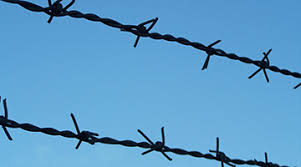 of the way. Second, nail a new piece of wire to a fence post with a fencing staple. You have to get the staple just inside of a barb to keep the wire from slipping through. The hard part is stretching the wire to the next fence post enough to get a barb there to use it to secure the other end of the wire. Sometimes my job was to get the wire in the fencing tool and pull it around the post using the post and tool for leverage. It wasn’t really easy. It required all my limited strength, and it caused me no small amount of anxiety, as my grandfather was not easy going about it. My efforts were usually subject to some harsh criticism.
In the end, though, the cows were always contained, and the fence was always mended – one way or the other. I never felt much happier about it, but that’s how life is when you raise cows. And the cows were fairly happy, I guess, having plenty of room to roam. It made you wonder why they’d ever want to escape in the first place, though sometimes you knew.
Every farmer needs a few bulls, of course, but not too many, so each year we’d cull some of the bulls from the herd and take them to auction where they were bought and either put to pasture or slaughtered. Unless they were breeding stock, the bull calves were castrated and sent on their way to become steers, as steer meat is more desirable than bull meat. I sometimes participated in the making of young steers. You may think the testicles are whacked off with a big knife or something, but we had a device with a strong rubber ring attached and stretched open. We’d pull the testicles through the open ring and then remove the device, which meant the ring constricted around the base of the scrotum. It’s anyone’s guess whether this was more or less pleasant than a big knife.
It wasn’t my concern to know what happened to the calves we sold. I do remember, though, returning to the lease one evening to find a mother cow wandering around the perimeter of the property braying for her calf. She was well-fed and cared for, but she depended on her son’s executioner for winter food, protection, and medication. This is humane farming, you see, not the horrible things you see in the smuggled films from factory farms.
I don’t know how long Mom continued searching and braying for her lost one.
if p then q ten year birthday party in Manchester
#PleaseHearWhatImNotSaying Poetry Anthology and Me
I am thrilled to have two poems in the new anthology, “Please Hear What I’m Not Saying,” edited by poet Isabelle Kenyon. The profits of the anthology will benefit the UK charity, MIND, which promotes mental health services and support while also working to reduce the stigma around mental illness. If I’m completely honest, I’m most excited to have my poems in the anthology because it is the first time any of my poems will appear in print anywhere, so I’m grateful to Isabelle for that.
Secondly, though, mental illness is a subject with deep meaning for me personally, which is why I decided to submit to the anthology in the first place. It is my personal belief that 100 percent of people experience mental illness at one time or another, but a fairly high percentage of us struggle for longer periods or with deeper pain. Over the course of my life (57 years as I write), I’ve had many happy times, but I have also been diagnosed with major depression, general anxiety disorder, insomnia, high blood pressure, migraine headaches, and the all-inclusive diagnosis of “stress.” In addition, I’ve pretty much diagnosed myself with Avoidant Personality Disorder just because I relate to every item on the list of diagnostic criteria.
If you look up statistics, you find that more women report depression, but more men die from suicide. You can make up your own mind about why this is the case, but I can tell you that over the years I have been told that my depression was a “luxury” and that it made me seem weak, pathetic, and selfish. If other men get the same message, it isn’t too surprising that fewer men report being depressed. When they do report mental illness, fewer services are aimed at them. Even when services are available to both men and women, the décor of offices and language of materials often has a stereotypically feminine feel that makes men feel unwelcome.
All of this makes me especially sensitive to the high-price of masculinity. We hear quite a bit about toxic masculinity, but toxic masculinity is a by-product of what philosopher Tom Digby calls sacrificial masculinity. Men are taught from the crib to ignore their own physical and mental health. In the past, men ignored their health in order to be better protectors and providers. Increasingly, emotionless brawn is less needed and less valued in society, so men are left with poor mental health with no obvious purpose, which only exacerbates the problem.
For a time, I facilitated men’s bereavement groups, and all the men said some version of the following: “I’ve been told how I’m not supposed to grieve (crying and emotional breakdown), but no one tells me how I am supposed to grieve.” Almost every man in every group I facilitated broke down in tears, and almost every one apologised for it. For this reason, I think if we can fight like men, we must learn to cry like men. Although I haven’t been successful at getting others to use it, I occasionally post information on men’s mental health with the hashtag #CryLikeAMan.
The anthology will be available from 8 February 2018.
Poetry Anthology benefits UK MIND
I was fortunate enough to be included in Isabelle Kenyon’s new poetry anthology supporting the mental health charity, UK MIND. I was happy to participate in the project because I think any effort to remove stigma around mental illness and to provide support for those suffering is a good and necessary thing to do. I don’t think I am unusual, really, but I’ve had my bouts with depression, anxiety, avoidance and attendant health problems. The more open we can be about our struggles, the easier it will be for us, collectively, to cope. I’m very grateful to Isabelle Kenyon for her efforts, which she describes below.
______________________________________
Isabelle Kenyon is a Surrey based poet and a graduate in Theatre: Writing, Directing and Performance from the University of York. She is the author of poetry anthology, This is not a Spectacle and micro chapbook, The Trees Whispered, published by Origami Poetry Press. She is also the editor of MIND Poetry Anthology ‘Please Hear What I’m Not Saying’. You can read more about Isabelle and see her work at www.flyonthewallpoetry.co.uk
Thank you to Randall Horton for letting me guest blog today! I wanted to spread the word about the MIND Poetry Anthology, which I have compiled and edited. ‘Please Hear What I’m Not Saying’ will be out in early February, expected date of release to be Thursday the 8th, on Amazon. The Anthology consists of poems from 116 poets (if I include myself!) and the book details a whole range of mental health experiences. The profits of the book with go to UK charity, MIND.
The book came about through my desire to do a collaborative project with other poets and my desire to raise money for a charity desperately seeking donations to cope with the rising need for its work. I received over 600 poems and have narrowed this down to 180.
As an editor, I have not been afraid to shy away from the ugly or the abstract, but I believe that the anthology as a whole is a journey – with each section the perspective changes. I hope that the end of the book reflects the ‘light at the end of the tunnel’ for mental health and that the outcome of these last sections express positivity and hope.
Please Hear What I’m Not Saying Q&A
‘Please Hear What I’m Not Saying’ is a poetry anthology, the profits of which will go to UK charity, MIND. The book consists of 116 poets (I’m happy to be one of them) from around the world and details a whole range of mental health experiences. The expected date of release is Thursday 8th, on Amazon.
Editor Isabelle Kenyon answers questions about the project.
Question: How did this project begin?
Isabelle: I knew I wanted to work collaboratively with other poets and it was actually the theme of mental health for a collection, which came to me before the idea of donating the profits to charity MIND. This was because I knew how strongly people felt about the subject and that it is often through writing that the most difficult of feelings can be expressed. I think that is why the project received the sheer number of submissions that it did.
Question: How did you select the poems – was there a process?
Isabelle: In some cases of course personal taste came into my selection, but I tried to be as objective as I could and consider the collection as whole. I wanted the book to have as many different personal experiences and perspectives as I could find. Because of this, I have not been afraid to shy away from the ugly or the abstract, but I hope that the end of the book reflects the ‘light at the end of the tunnel’ for mental health and that the outcome of these last sections express positivity and hope.
Question: Why should people buy this book?
Isabelle: Easy – to support the fantastic work which MIND does and to support the fantastic poets involved. Rave about their work because I believe the poets involved are both talented and dedicated.
Guest editor alert!!
In US, Illness is Financial Anxiety
In August 2016, I moved from Texas to the northwest of England. Last summer, I while walking in the local park I slipped on a stepping stone and sprained my ankle. As the pain pulsed through my body and my ankle began to swell, I began to wonder whether I needed an ambulance, an x-ray, or possibly even surgery.
I did not think about the cost of an ambulance or whether my insurance might refuse to pay for it, the cost of an x-ray if needed, the price of surgery, or even co-pays for medication or any possible treatments. I was worried only about my condition and getting better.
I enjoy hiking, cycling, dirt bike riding and other sports with risk of injury, so I’m not unaccustomed to dealing with the occasional injury. With similar injuries in the United States, though, I always thought immediately of the cost. Mind you, I was never uninsured, but even with insurance proved by the college where I taught, a shattered tibial plateau in 2001 that required two surgeries and months of physical therapy left me with surmountable but daunting bills long after I had recovered. Since 2001, prices have risen dramatically along with higher deductibles, narrower networks, and higher copays for treatment.
In the United States, illness or injury means an immediate calculation of costs and threats to financial security even for working people securely in the middle class. For others, the situation is much worse. Of course, long-term illness or injury can throw middle-class workers out of work, which means they will lose their insurance, unless they can afford COBRA payments to maintain their insurance for a limited time after employment. In my experience, COBRA payments are much higher than people expect or are able to pay.
As a student in medical humanities, I read many narratives of illness. They all focused on suffering from the condition, facing mortality, finding or making meaning in the face of prolonged pain, but not so much about what truly horrifies Americans when they fall ill. Illness or injury should be a time to focus on healing, if possible, or confronting or preparing for prolonged pain in the case of a chronic condition, or to prepare for death in the case of terminal illnesses. It should not be a time to worry about financial ruin for oneself and one’s family.
The study of medical ethics offers many opportunities to contemplate challenging philosophical problems with rich and varied intellectual interest. However, access to healthcare is by far the most pressing problem in the United States. Anyone concerned about illness, suffering, and medicine must assume the obligation to relieve the suffering created by unaffordable healthcare.