Grief and the problem of meaning making

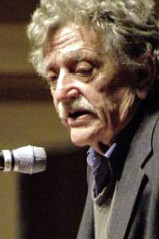
Kurt_Vonnegut_at_CWRU
Kurt_Vonnegut_at_CWRU (Photo credit: david_terrar)

I’ve been reading Kurt Vonnegut again. It is a bad habit I started as a teenager. When I began reading Vonnegut, I was a classic example of a depressed teenager, or at least that was how I saw myself.

Looking back, I realized I had many reasons to be sad. Extremely sad, even. A friend had died in a motorcycle accident when a car pulled in front of him in our own neighborhood, and then my uncle, who was 25 years old, died in a fire that consumed the mobile home he was living in. Of course, a few other bad things happened, too, and the world just seemed a little crazy to me, not fair at all.

My confusion was confounded by the fact that I would often hear family members ask one another, “Do you think someone is trying to tell you something?” They searched each devastating event for a message from God. If something bad happened, it was because we had done something wrong. At church, I learned that all the pain, all the trials, and all the trauma was part of God’s plan, even if no mortal could make heads nor tails out of the plan. I hadn’t read Kierkegaard yet, but I was told to take a “leap of faith,” and then I was thrown off a cliff of faith.

Søren Kierkegaard (Copenhague)
Søren Kierkegaard (Copenhague) (Photo credit: dalbera)

So, around that time, I read about Kurt Vonnegut’s unlucky sister. In the prologue to Slapstick, he told of how while his sister, Alice, was dying of cancer, her husband, who was to take care of their children after her death, died on “the only train in American railroading history to hurl itself off an open drawbridge.” It was bad luck—bad enough to make you feel a little depressed.

But Vonnegut always made me feel better about things. He said, “Since Alice had never received any religious instruction, and since she had led a blameless life, she never thought of her awful luck as being anything but accidents in a very busy place.” Although I have received prodigious religious instruction and led a life full of blame, that one line has gotten me though many dark moments.

Over the years, I’ve heard many people tell me that bad things were part of some tortuous plan by some deity or other, I’ve heard that children are only on earth as a “loan” from God, and I’ve heard that God won’t give us more than we can handle. It seems to me that people routinely get more than they can handle. Many people die from stress-related illness or suicide, brought about by despair and a massive inability to cope with life’s tribulations.

Ah, but the people who didn’t survive just didn’t have enough faith to get by. The message I got from this was: “Be strong—or God may kill you.” If I had no faith in the purely accidental nature of bad luck that I learned from the Vonneguts, I am not sure I could have survived my life, which really only has the normal amount of sorrow and trauma. I haven’t been spectacularly unlucky, even by first-world standards.

Thanks to some of the interpretations I have heard of the meaning of traumatic events, I get a little nervous when anyone starts talking about making meaning of suffering. I’m quite happy to believe that suffering is just one of the vagaries of an existence fraught with peril. According to a paper by psychologist Robert Neimeyer and his coauthors, people have an intense need to “make meaning” after an extreme event disrupts their life narrative. Through a process of making meaning, individuals are able to restore a coherent narrative of their lives.

Part of the problem, it seems, is that most people believe the world has a certain moral order, and that people who are good will be rewarded with positive outcomes. So, when bad things happen, we will surely ask, “Why me?” This is a question Alice Vonnegut never asked herself, according to her brother, anyway. The horrible luck she had did not interrupt her narrative because her narrative was one of randomness and accidental events.

Regardless of what narrative one tells regarding the moral order of the universe, many people do see their own moral or spiritual growth as a result of suffering. Indeed, when we meet young people who are self-satisfied and callous, we often think that they will grow as they meet with grief and loss, and that growth will bring wisdom. It is good to know that our loss can make us better people, but I can’t think of a time when I would not give up my personal growth in order to have a loved one restored.

It seems somehow wrong, ethically wrong, to look toward loss as an opportunity for growth, but we do not seem quite so bothered by looking backward to a loss as a catalyst for growth. Herein lies some of my discomfort with focusing too clumsily on making meaning—it almost implies approaching loss by asking, “What can I get out of this?” Alternatively, it invites people to celebrate what they gained from loss. This, in itself, can create moral distress.

To be sure, psychologists such as Robert Neimeyer emphasize accompanying the grief-stricken on their own journey without guiding them down any particular path. People will, naturally, have to determine what their loss means and also what meaning they assign to life after their loss. If they fail to find any meaning, they may lose their lives all together.

In the quest for meaning, though, I hope we can accept that we live in a world full of hazards, and they do not affect us in any rational order. It turns out that some really awful people live rather charmed lives, and the purest and most compassionate people in the world suffer, though not always.

If we have the strength, we put one foot in front of another one more time. And, maybe, once again.

My question for Ron Paul: Autonomy and health care

Earlier this year at the Tea Party debate, Wolf Blitzer asked Ron Paul if a person who chose not to buy health care should be left to die. Paul responded that this person’s friends and community could support him and pay his bills. Many in the audience seemed to be all right with letting this person die.

Conservatives and libertarians both express a strong commitment to autonomy, which they sometimes refer to as freedom. The new health care law is unacceptable they say, because it requires individuals to purchase insurance. People should not be required to purchase insurance, but they should be responsible for the consequences if they do not have insurance. Of course, this scenario is rarely a problem for anyone, and Blitzer asked the wrong question.

I would want to ask a different question. I want to know about the person who has worked all her life and been successful. After 20 or 30 years, she decides to expand her opportunities by starting her own business. Remarkably, her business is profitable in its first year. She can afford to buy insurance, but she cannot buy adequate coverage because she has preexisting conditions that every major insurance carrier refuses to cover. When she contracts a serious illness, she is driven into bankruptcy because of medical bills that are astronomical but quite common. Should our country let her die? Should she be permitted to slide into bankruptcy?

Autonomy is not quite as simple a question as it apparently seems to Republicans and libertarians. Philosopher Isaiah Berlin described two types of liberty: one is negative and the other is positive. For conservatives, it is imperative that individuals not be forced to do something they may not want to do and no government intrusion is acceptable. This is negative liberty. For liberals, such liberty is meaningless if one is unable to make the choices he or she desires, which is positive liberty.

Describing the liberal view of positive liberty, Berlin says,

“It is true that to offer political rights, or safeguards, against intervention by the state, to men who are half-naked, illiterate, underfed, and diseased is to mock their condition; they need medical help or education before they can understand, or make use of, an increase in their freedom. ”

While conservatives will not force someone to purchase insurance, liberals want to ensure that everyone has the option to have health care. Everyone who needs health care and cannot obtain it becomes a liberal in an instant.

The number of uninsured in the United States is said to be around 50 million, but many more than that have inadequate insurance. Unfortunately, most people do not realize they are underinsured until it is too late. Many people only learn that their treatment will not be covered by insurance after they have received the treatment. What kind of autonomy is this? What is the value of liberty if it leaves one with no options to avoid bankruptcy, untreated illness, and death? Is this really what we want to be?

Camus on Wall Street

As a young man, angry as I was, Albert Camus spoke to me. Many described him as an existentialist who focused on the absurdity of life, which was true, but I think it missed the point. At the very least, it missed the main point I took away from his work. After going through some periods of despair, I found “The Myth of Sisyphus” to be uplifting and inspiring. Camus offered the surprising revelation that Sisyphus could be happy. Actually, Camus said we must imagine Sisyphus happy. If Sisyphus is happy, surely anyone can be.

But Camus does not tell us to choose to be happy in spite of our circumstances. He does not tell us to turn inward in a meditative trance to achieve happiness. He does not tell us to live in the moment. No, it is a defiant spirit that keeps Sisyphus happy. Sisyphus has the misfortune of not only having a dreary existence but also of being all too aware of it.

Many people appear to go through life without ever realizing they are living a pointless and dreary existence that would be torture if they thought about it for one second, but they do not think about it. Or they try not to, but Sisyphus does think about it. Camus says, “The lucidity that was to constitute his torture at the same time crowns his victory. There is no fate that cannot be surmounted by scorn.” It is scorn for his masters that gets him through the day. Even if he cannot change the situation, his hatred for his masters is a victory over them.

So some of us continually rail against the state of the world, and we are counseled to accept our reality, count our blessings for what we do have, be productive, and live in the moment. Our rage, we are told, prevents us from being happy, but I think our rage, our scorn, our repudiation of injustice is what sustains us and gives us meaning. It gives us happiness.

Our scorn and anger sustain us because they declare that we are something of worth, even if we are worthy only to ourselves. In The Rebel, Camus says, “In every act of rebellion, the rebel simultaneously experiences a feeling of revulsion at the infringement of his rights and a complete and spontaneous loyalty to himself.” Rather than being a negative, rebellion is a positive expression of one’s humanity. To do otherwise is despair, which is silent. Camus says, “To remain silent is to give the impression that one has no opinions, that one wants nothing, and in certain cases it really amounts to wanting nothing.”

Bewildered pundits, reporters, political observers, and sedated citizens ask what the protesters on Wall Street hope to accomplish. They have already accomplished something important. They have said, “no.” They have begun to live. They have chosen to want something.

Can philosophy matter?

In the last century, it seemed philosophy might disappear from public consciousness. Much of philosophy had become so technical and so removed from the problems of daily life that most people who were not professional philosophers could not even name a living and working philosophers. Philosophers hardly have the recognition of other public figures even now, but they are addressing concerns that are public–medical ethics, corporate ethics, how to live a good life, and so on.


In Stephen Toulmin’s book, Cosmopolis, he describes various aspects of modernism, and concludes that it is no accident that philosophers are beginning to take seriously concerns that Descartes thought had no depth. After centuries of theoretical and technical exploration, philosophers are returning to discussions of how to live and how to make life better for others. Toulmin says it is no accident that “more and more philosophers are now being drawn into debates about environmental policy or medical ethics, judicial practice or nuclear politics.”[1] He says some philosophers may fear being drawn away from the technical questions of academic philosophy, but he argues, “These practical debates are, by now, not ‘applied’ philosophy but philosophy itself.”[2] The problems facing the world now are not new. Wars, pollution, and poverty have been with us for centuries. But these same problems are acute, chronic, and critical. It is easy to despair at our lack of progress, but Martha Nussbaum reminds us that progress has been made. In Frontiers of Justice, she says, “Racial hatred and disgust, and even misogynistic hatred and disgust, have certainly diminished in our public culture, through attention to the upbringing of children and their early education. The careful attention to language and imagery that some pejoratively call ‘political correctness’ has an important public purpose, enabling children to see one another as individuals and not as members of stigmatized groups.”[3] As humanists, we cannot solve the world’s problems, but we can choose to contribute to moral progress and promote a common understanding and care for one another, regardless of how many people join us along the way.


[1] <!–[if supportFields]> ADDIN ZOTERO_ITEM {"citationItems":[{"uri":["http://zotero.org/users/141815/items/3W4MJ9MI"]}]} <![endif]–>Stephen Edelston Toulmin, Cosmopolis: The Hidden Agenda of Modernity, University of Chicago Press ed. (Chicago, IL: University of Chicago Press, 1992), 190.<!–[if supportFields]><![endif]–>

[2] Ibid.

[3] <!–[if supportFields]> ADDIN ZOTERO_ITEM {"citationItems":[{"uri":["http://zotero.org/users/141815/items/2R3RZAXP"]}]} <![endif]–>Martha Craven Nussbaum, Frontiers of Justice: Disability, Nationality, Species Membership (Cambridge, MA: The Belknap Press, 2006), 413.<!–[if supportFields]><![endif]–>

On Lying

Anyone who has taught an introductory course in ethics has discussed the morality of lying, and most of us find that few people endorse an absolute prohibition against lying. Though we like to reject “situation ethics,” we tend to say that whether one should lie “depends on the situation.”

Lies
Lies (Photo credit: Gerard Stolk (vers l’Avent))

Against Kant’s absolute prohibition of lying, we offer the Murderer at the Door who wants to kill our innocent children. Surely, we should lie to throw the murderer off the trail of our children and, one would hope, into the hands of the police. This kind of lie is justified because it saves or has the potential to prevent great harm, or so it seems to some of us who don’t find Kant compelling.

On the other end of the spectrum, we find ourselves wanting to demand the truth even when dishonesty (or withholding the truth) appears harmless. We have the case of police who have taken embarrassing photos of an assault victim to be used as evidence against the perpetrator but who then use the photos for the amusement of themselves and their colleagues. The victim may never be affected by this secondary use of the photos so long as the victim remains completely unaware of them. Doing such a thing seems quite wrong, though, or at least it does for me.

In relationships, we have all kinds of information that could help or hurt our partners. Should we tell them what their friends have said about them behind their backs? Should we go so far as to tell a complete lie (“No, Susan has never said an unkind word about you!)? Learning every detail of what your friends and colleagues have said about you is likely to be painful at best. I personally recommend sheltering yourself from this as much as possible. I also think it is possible to share too much information.

On the other hand, if your friends are so hateful towards you that they cannot be considered friends, you might want to know that. So, we are tempted to say we want complete honesty except when it is more painful or harmful than a lie. This leads to the problem that we do not always know what is better or worse in the end. Lies have unintended consequences, and we feel responsible for their consequences while we do not feel personally responsible for the consequences of the truth, although many people have said something along the lines of “I never should have told the truth!”

So, we are left with decisions based on the context and situation. We must choose between protecting someone’s feelings and offering full disclosure. There are a number of things we can consider in our decisions. First, I think we may consider how the other person will react if the dishonesty is discovered. Many people have said that if their death is imminent, they would want their friends and family to lie to them.

We can also consider our own motivation for the lie. Are we lying to protect others or to protect ourselves from taking responsibility for our own actions? When we are only trying to cover our own footprints to avoid having to confront truths about ourselves or our actions, I think the lie is most likely not justified.

Finally, as much as consequences cannot be predicted, we really must think of what outcome we are trying to achieve. In many ways, this last consideration echoes the first two, but it deserves a little focus on its own. We must think of what good the lie may produce if it is believed and what pain it may produce if it is exposed. I suppose we must also attempt to evaluate what pain may result if a lie is believed. (E.g., what is the harm in telling people they will live 10 years when you know they have only a few hours left?)

Commodifying Mindfulness

I attended a presentation last week on the use of mindfulness in marriage and family therapy. I don’t know a lot about Buddhism and would never claim to be an expert. What I do know of Siddhartha Gautama leads me to view his writings as moral writings. In other words, I do not see them as a guide to the good life but as a guide to how to be good. I may have missed the point here, and I’m glad to be corrected, if anyone reads his words differently. I also realize there is room for interpretation. Nonetheless, I don’t think his goal was to teach people to have a more pleasurable existence or to achieve greater success in business. I also wonder as to whether he intended to help people improve their marriages, considering that he abandoned his wife and son when he left for his journey to confront suffering in the world.

Statue representing Siddhartha Gautama.
Statue representing Siddhartha Gautama. (Photo credit: Wikipedia)

The presenter I saw began by mentioning Siddhartha. He said, correctly, that there were four noble truths, but he did not mention what the first three were (they have to do with life as suffering or sorrow, the causes of sorrow, and the extinction of sorrow). The fourth truth is Siddhartha’s dharma, or teaching of “the way.” The word “dharma” is not specific to Gautama. Anyway, Buddha suggests we can achieve enlightenment by following an eightfold path. The presenter I saw mentioned only the seventh fork on the eightfold path, which is mindfulness.

By doing this, he ignored all the negative precepts of Buddha’s teaching. He left out the stuff about avoiding sexual misconduct (interpret how you will), lying, gossiping, killing animals (vegetarianism seems recommended), and a number of other things. Now, Buddhism, as I understand it, has no commandments, so no one is obligated to be a celibate vegetarian who never speaks, but these are suggestions as to how one might find enlightenment, the goal of which is extinction of individual consciousness. Once we are freed from the cycle of samsara, we will pass into a state of universal awareness, which negates the awareness of any individual.

Given that Buddhism does not recognize the existence of individuals and views all sorrow as universal sorrow, it seems unlikely that Gautama intended to help people achieve individual fulfillment. Indeed, when we take action to relieve suffering, the good of the action is not the good of an individual but the good of the universe. Similarly, the suffering of an individual is only (!) the suffering of the universe. To be freed from this suffering, we must no longer think of the individual, we must not think of our selves. So long as we do, life, which is sorrow itself, will continue.

A universe without suffering is a universe without life in it, least of all life that is conscious and driven by individual needs and desires. In Buddha’s scheme, mindfulness is one tool to help achieve this ego-less state. It is a moral guideline. It is not a way to focus on our goals and what is keeping us from them. It is not a way to relax. It is not a way to be happier. It is a way to be good and right. While I am not a Buddhist and will most likely never become one, I still respect the efforts of people to be better people. Buddha abandoned his family and friends to try to save the universe. Maybe he made the right choice, and maybe he did not, but I feel using mindfulness in a superficial manner is disrespectful of the effort. Using Buddha’s teaching to make money is even more offensive to me, but I suppose I’m easily offended.

Can we talk?

In recent months (perhaps years, now), it seems the religious and irreligious are divided more severely than ever. In response to demands that intelligent design be taught in schools or that evolution not be taught, writers such as Sam Harris, Daniel Dennett, and Richard Dawkins have taken religious thinkers and writers to task, attacking religious thought with unbridled enthusiasm. Their writings serve more as a rallying cry than as discourse and, as such, probably exaggerate the true gap between believers and non-believers in our society. Some of the religious seem equally enamored of raising arms against the other side. The Terri Schaivo “debate” quickly devolved into nothing more than grandstanding, posturing, and provocation for combat. With no background knowledge of our society, one would think pluralism had only happened moments ago and that any kind of discourse between the two sides (indeed, there are far more than two sides, but such nuance is invisible at the moment) is impossible. A little reflection, however, will remind us that the United States, while not quite the rich and diverse mosaic some dream it has been, is a country that has managed discussion between divergent groups in the past. The founders of our country were both religious and secular. Although a fair amount of strife resulted, discussion and compromise were always seen as real possibilities. It is possible that a way forward still exists.

When asked who would be an authority on matters of morality, most members of the public, in the United States at least, would first mention members of the clergy. More sophisticated individuals might know to mention theologians specifically. Few people would think to mention philosophers, especially not secular or, worse, atheistic philosophers. In The Elements of Moral Philosophy, James Rachels says:
“It is not unusual for priests and ministers to be treated as moral experts. Most hospitals, for example, have ethics committees, and these committees usually include three types of members: healthcare professionals to advise about technical matters, lawyers to handle legal issues, and religious representatives to address moral questions.”
So, most people in the U.S. believe morality and religion are inseparable. Rachels refers to Plato’s Euthyphro to question whether God’s morality is arbitrary or rational. If actions or values are good only because God commanded them, then morality is arbitrary, or so the argument goes. If God commanded actions and values because they are good, then God’s morality is rational. Rachels quotes Gottfried Leibniz saying that the latter must be true. He says, “For why praise him for what he has done if he would be equally praiseworthy in doing exactly the contrary.” If God’s actions are rational and not arbitrary, then any rational person should have an equal ability to examine moral questions on the basis of reasoned argument. Rachels’ argument is that atheists and secularists should be included in moral discourse.
It is surprising, then, to find that the theologians Rachels felt have an undeserved place of privilege in moral discourse should complain that they have been left out of moral discussions, particularly with regard to bioethics. Courtney Campbell writes, “One unfortunate aspect of civic bioethics . . . is its incivility, including incivility toward religiously grounded opinions.” He also warns that religious bioethicists cannot retreat to the academy as, “the academy exhibits its own forms of intolerance toward religious expression.” Rachels and Campbell appear to be living in two different worlds, one hostile toward the secular and one hostile toward the religious. Authors on both sides declare that they must fight to be included in the discussion and be heard over the tyrannical forces of the opposing side.
Certainly, each side is correct in at least a surface view of discourse in the United States. Most people in the United States are religious, and their religious values are reflected in the public sphere. Some religious groups have shown clear forms of intolerance for opposing views. On the other hand, many professional philosophers are secular or atheistic, and a condescending attitude toward religion is perceptible to even beginning students in philosophy. Philosophers are a small minority, indeed, but their voices are disproportionately loud in the debates over bioethics, at least in part because they have made some provocative claims. How is a religious person to speak to a philosopher who claims it is permissible to kill babies and disabled adults but not animals? The fact that such a question is even asked must be enough to make some religious writers feel dialogue is hopeless.
James Gustafson describes three styles of religious discussion in medical ethics. The first is based on autonomy of religious views; most people would generally associate this view with an assertion of religious authority. When asserting authority, one is likely only to sway those of the same faith who feel compelled to follow the authority of its leaders. This is, of course, an important part of the moral work of many theologians, but it does not engage the wider community. The second style stresses continuity with the wider community. This style seeks to make religious positions intelligible both to those within and beyond a specific religious community. For example, a Catholic theologian may publish and article or give a speech intending to make the Catholic position on social welfare or just war comprehensible to non-Catholics. In doing so, some non-Catholics may come to agree and join with Catholics in support of or opposition to public policies. The final style is interaction, which is the only style in which the religious interlocutor is open to revising his or her original position. The interactive style is not for every writer or every occasion, but Gustafson notes that it is possible and can provide a space where the religious and the secular can converse about matters of medical morality.
J. Bryan Hehir discusses the role of the “public church.” In examining the proper role of Catholic bioethics, he notes that the Catholic Church “defines civil society as both an audience for its teaching and an object of its pastoral care.” From this prospective, theologians and others are obligated to engage the wider, pluralistic public on important matters of morality. He says that religious writers must be prepared to contend with a pluralistic society, a secular state, and a liberal philosophy of law. He notes the success of Martin Luther King in addressing the public on moral matters using rational argument that was not free from religious significance. However, biomedical issues seem especially intractable, particularly with regard to issues related to sanctity of life (e.g., abortion, suicide, euthanasia).
Given the steadfast opinions of individuals on both sides of the abortion debate, many have advised Catholic writers to focus attention on the ecclesial community. Hehir finds this dissatisfying as he advocates a public church, not a church that restricts its reach to its own enclave. He says, with some apparent pride, “The strategy may ultimately fail, but the failure will be that of a public church, rather than a decision by a once-public church to retreat within a purely ecclesial definition of its role.” The question is not whether the church succeeds or fails but whether it fulfills its duty to society as an object of pastoral care.
Hehir moves to another issue that may seem to be less of a problem for discussion between the church and the secular public: public access to health care. While religious language may be used to discuss health care, the general public can certainly understand the positions of the church, and the issues are not nearly so intractable as discussions of abortion, for example. On the surface, it seems that the church would be obligated to support efforts at providing heath care to all, but Hehir sees a problem. Many proposals for public access to health care include provisions for publicly funded abortions. He suggests that multiple strategies could be adopted but not in his short essay. Fortunately, Andrew Lustig expands on the discussion of health care rationing and reform, but the problem remains frustrating. Lustig recalls Christian teaching that demands universalizing love and care for one another, which would seem to require support for public access to health care, perhaps even globally. Nonetheless, he notes that U.S. bishops oppose any health care package that includes abortion. He calls for religious writers and others to invite their religious values to drive arguments expressed in non-parochial, or public, terms. He sees a possibility that religious values will “work their leaven upon the world” indirectly. How is a secularist to respond?
Two secular philosophers, Peter Singer and Peter Unger, have devoted much of their attention to the ethical use of the world’s resources. Both are motivated by a value shared by all Christian writer’s I am aware of: a value of preserving the lives of those who wish to live. Admittedly, some Christian writers would want to preserve lives in cases where someone might want to die, but it is possible to bracket that concern while discussing our individual obligation to others who do want to live. Singer and Unger both argue that taking care of the world’s most vulnerable people is an individual responsibility for everyone. While they both eschew religious language, others have pointed out that only Jesus seemed to have an ethic as demanding as Utilitarianism, requiring all in affluence to give to any who need assistance. Singer and Unger are both Utilitarians (a frequent straw man for non-Utilitarian ethicists) and argue that the interests of all must be considered equally (for Singer, the interest of animals must also be part of the calculus).
On the point of health care in particular, Singer questions the claim of Christians to value all lives equally. He challenges the notion, saying that to value all lives equally would mean spending as much money to save the lives of the world’s desperately poor as we spend saving premature infants and those in the last stages of life. Many of Singer’s positions are anathema to Christian thought and tradition, but on this point common ground seems possible. While not responding specifically to Singer and Unger, Edward Langerak gives an example of a kind of language that is distinctively religious yet still capable of engaging secular philosophers. He notes that religious covenant requires individuals to love their neighbors. He acknowledges that “the problem has usually been that people’s sense of obligation is too minimal for covenantal flourishing.” He quickly adds, “But some special covenants seem especially prone to encourage a ‘savior’ mentality in which persons lose themselves in a bottomless pit of others’ needs.” His language is decidedly religious, but it echoes secular arguments against the Utilitarian calculus. Both the Utilitarian and covenantal ethicist can “bury the self in the bottomless needs of others.”
James B. Tubbs grapples with the question of obligation to strangers. Tubbs exclaims, “Yet Jesus goes beyond the claim that needy strangers should be regarded in the manner in which God regards them. He suggests, in fact, that the needy stranger be regarded as the Son of Man himself!” Tubbs emphasizes this point further by admonishing that the encounter with the stranger should be seen as an encounter with the divine. He then moves to an examination of what it means to be a neighbor. He declares that our moral life is dependent on relationships with others, but he leaves off the discussion of what this relationship demands of us. It would not be difficult for the Utilitarian to agree that strangers shape our moral lives, but it seems more difficult for Utilitarians to turn away from what our relationships demand of us. In any case, it is not religious language or hostility to religious thought that prevents Utilitarians and religious writers from becoming interlocutors. One has no difficulty imagining a discourse on our obligations to strangers between the secular and the sectarian. A certain degree of consistency is of value in any moral tradition.
I have focused so far on obligations to strangers as it seems to me to be the most pressing medical issue for everyone. More than four million people die each year from starvation. Millions more die from treatable or preventable diseases. While academic bioethicists grapple with deep quandaries regarding patients and the role of the doctor at the bedside, most of the world would be improved greatly by having the luxury of becoming a patient rather than another statistic. War and its always-attendant famine kills far more people than withdrawal of treatment from impaired newborns or cessation of treatment for the cognitively impaired. This is not to dismiss the importance of discussions over transplantation and other hard questions, but the easy questions may be a good place for secular and sectarian interlocutors to begin a discussion. An infinitesimally small number of people discussing bioethics and medical humanities would claim that the loss of life is insignificant. Whether the author values life because it is a gift from God or because it is something individuals have developed an interest in maintaining, life is something to be preserved, at least in the cases where the living person values his or her life. Given the almost universal agreement with this statement, it seems that philosophers, theologians, and bioethicists of every stripe could work together not on whether life should be preserved but on how public policy can be shaped to help those who need medical care and cannot procure it. It has perhaps been avoided too often because the task is more daunting than deciding at what moment a dying person becomes a corpse with organs suitable for donation. Nonetheless, if we are to encounter strangers as our neighbors, we must gird ourselves for the struggle and prepare for a significant shift in how we view our fellow sufferers in the world.
If a discussion of helping the world’s neediest individuals seems possible among people of many faiths and philosophical dispositions, Leigh Turner’s example of blood transfusions will have us despair that no discussion is possible in other areas. To be sure, people from many backgrounds would agree that blood transfusions are often required to prolong lives. Many would see providing transfusions to be an obligation of the highest order. Turner points out that none of this rhetoric or consensus of most bioethicists will be of interest to Jehovah’s Witnesses. Turner warns, “Principlist and case-based approaches to moral deliberation typically exaggerate notions of common morality.” The point deserves consideration. It is naïve for any bioethicist to assume that any argument, no matter how well reasoned, will be accepted by all. Turner accuses bioethicists of ignoring the elephant in the room, but this conclusion may be rash. It could be that bioethicists, aware of the elephant in the room, persevere in the hope of lighting one candle rather than cursing the darkness.
It is no question that philosophers and theologians often talk past one another. Many religious concepts cannot be put into a language common enough for the secular and the sectarian. This should not mean, however, that the conversation should not begin. The “public church” should make its beliefs as clear as possible to even an unreceptive audience. The public intellectual should do the same. Resistance should come from all who have the strength of their convictions regardless of whether those convictions come from religious moral traditions or reasoned argument and reflection. Speaking one’s conviction publicly and arguing for it is itself a moral act. Tolerance and respect for diversity do not require us to stifle our voices. They require us to accept that other individuals have the same right and obligation we have to express their deeply held convictions and beliefs.
Public policy, on the other hand, must reflect the greatest respect for individual beliefs and convictions that cause no harm to others. To be sure, it is not easy to decide what beliefs cause harm to others. The case of blood transfusions from the Jehovah’s Witnesses’ point of view is a reminder that sometimes harm seems quite different when seen from different vantages. I personally am concerned about harm done to animals. I realize that most do not consider harm to animals to be harm at all. I join the relatively small group of individuals, mostly but not exclusively secular philosophers, in explaining why much of the harm to animals seems not only cruel but unnecessary. I have learned that the stronger claim that animals should not be harmed or used in research is almost universally rejected, but many people of various faiths and backgrounds accept that cruelty is an evil. Deontologists and virtue ethicists both reject cruelty to animals as a bad habit that could lead to cruelty to humans. Thus, Kant and Aquinas both reject direct obligations to animals but see humane treatment of animals as an indirect obligation to humans. Those with sufficient openness have been able to discuss this subject with respect and results. Globally, a shift toward more humane farming is underway even as factory farming continues to be the most profitable means of producing food.
We can and must engage one another in discourse with respect, tolerance, and courage. The debate will not always produce an answer that is accepted by all, but the lack of debate will always produce frustration and power struggles. Bioethicists are in a position to model such discourse for the larger society. This will require leaving the enclaves of institutions and entering the public sphere in a more visible manner. We must take care to live by the principles we espouse. Peter Singer has been criticized for donating only 20 percent of his salary. He admits he could do more but also points out that it would not be necessary if everyone living in affluence would give only one percent of her or his income. We have achieved nothing near this level of giving, but aid organizations did see a spike in donations after Singer’s essay on world poverty appeared in the New York Times. It is certain that atheist Singer managed to engage the religious with his argument. Discourse can have positive results.
Ronald Carson writes, “In covenant, one receives others as one receives a gift—in trust—and one passes the gift on in response to need, with due regard for the recipient, and without calculation.” Our fellow ethicists are in need of respectful interlocutors just as our fellow humans are in need of medical assistance. As bioethicists, medical humanists, and responsible human beings, we can help provide insight, assistance, and advocacy. We can join and be fully engaged in a moral community. This is the task at hand.

Conceptual difficulties regarding God

Many people are committed to the idea of theism. When a person claims to be a theist, though, we learn nothing regarding the person’s position to any particular conception of God, so all we know about this person is that she prefers to not be described as an atheist. Some people are intentionally vague claiming only that there is “something bigger than myself” or that there are universal mysteries that the human mind cannot comprehend. Others claim that they cannot conceive of ethical principles being true without the existence of some God, so God must exist in order to be good. It is not possible to prove these claims right or wrong because they are incoherent.

When one refers to the mystery of the universe, for example, what claim can such a person possibly make by this statement? The universe is, indeed, quite large and complicated. The human mind has many limitations that prevent any accurate perception of the universe. We can imagine that there is a mind that can perceive the universe, but we cannot imagine constructing any argument or test that would give evidence of this infinite, or at least quite large and complicated, mind. The only thing as large and complicated at the universe is the universe, unless we conceive of God to be larger and more complicated than the universe, then the mystery would be how something smaller than something else could come to be called the universe, for “universe” seems to be an all-encompassing term. If God is larger and more complicated that what we know is the universe, then the universe is not universal, and God is the universe, whatever that may be.

Now, we can claim that God does encompass all and also claim that with out limited minds we can observe and understand at least parts of God (the part that commands or desires us to be kind to one another, for example), but when we observe things in this way, we must always be aware that God’s observations may not look at all like our observations of even small and simple matters. Unfortunately, humans cannot see any perspective other than the human perspective. We could even challenge this view further and say that one cannot perceive any perspective other than one’s own.

The fact that we have perceptions, though, is evidence for some that God is necessary. All perceptions must come from somewhere, so there is a source for all of experience. Some call that source of perception God, but reasons for calling it “God” are not readily apparent. This appears to be motivated only by desire for something that can be called “God.” That our perceptions exist cannot be denied, for we cannot deny what we are experiencing. It seems natural to assume that all perceptions (and everything else in the world) has a cause, but this is a notoriously problematic claim.

How to have a lawn that won’t kill us all.

I’ve had several things to say about lawns. In the spirit of trying to offer alternatives, I will simply point you to an article from the UK both about the problems of lawns and the possible ways to deal with the problems. It is possible to live with beautiful gardens without pesticides, herbicides, fossil-fuel-burning and polluting lawn equipment, and water waste.

A Striped Lawn
A Striped Lawn (Photo credit: Wikipedia)

Of course, in the US, homeowner associations call the shots and insist on the destructive practices that the Guardian article is warning against. What is the solution? Fight the HOAs. Demand an end to environmentally destructive deed restrictions. We are not fighting to save the Earth. We are fighting to save ourselves.

More problems with lawns

Lawns continue to cause problems for the survival of animals such as humans. A New York Times article today reports on the problem of water conservation in Florida. In the article, Abby Goodnough notes that Florida residents use up to 75 percent of their water outdoors, mostly on lawns. Drought-resistant ground cover and artificial turf have both failed to catch on in big numbers. Why? Homeowner associations prohibit both. Instead, HOAs insist that homeowners have grass lawns, which require not only enormous amounts of water but also chemicals in the form of pesticides and fertilizers.

In other words, most Floridians (read: US citizens) are required to create environmental hazards around their homes. These hazards are harmful to animals, including humans, and are aesthetically bland at their very best. The fact that spending 75 percent of fresh water to maintain lawns is an unjust distribution of natural and financial resources seems self-evident to this author, but I’ve grown accustomed to being in the minority.

Perhaps HOAs are resistant because attractive alternatives do not exist. Artificial turf may not be the panacea some hope for as many find it less than beautiful. At least, many think they will find it less than beautiful. Perhaps to see it is to love it, but who knows? Some residents have also experimented with gardens made of rocks and hardy, ground-resistant ground cover. This gives a garden the look of a natural setting, which also seems upsetting to HOAs. A Zen garden filled with gravel and a few well-placed boulders might be attractive and encourage mindfulness at the same time, but I doubt HOAs will embrace the idea of Zen gardens soon, either.

What’s to be done? Some ideas: 1. pass laws limiting water consumption. 2. pass laws limiting the use of environmentally harmful chemicals on lawns. 3. eliminate HOAs. 4. encourage creative lawn maintenance. 5. remove all laws or deed restrictions requiring maintenance of grass lawns.

We will have greater property rights, lawns will reflect more diverse forms of beauty, water will be more abundant, and we will have a more just world. Not bad for a days work. Just let property owners do what they want to do, anyway.