Dangers of Anthropomorphism in Medicine (#poem)

chimpanzee sitting on gray stone in closeup photography during daytime
Photo by Pixabay on Pexels.com

It is most important, he said, to never
Ascribe to your subjects the feelings,
Intentions, and desires of humans.

You must make assiduous reports
Of behavior devoid of motive or
Explanation. The maternal adult screamed

But never wailed in sorrow, for
We cannot assume she is capable
Of sorrow. We cannot assume

Her frantic clamoring expresses
Either desperation or lamentation for
The infant stolen from her hours before.

We cannot assume she feels what
Humans feel or, indeed, is capable
Of thoughts or intentions at all.

But do remember that our work
Is important, as these specimens
Are perfect subjects for the study

Of human medicine. Their biology
And neurology is so similar to human
Biology that we can safely assume

That any treatments developed
For them will have similar effects
On their human counterparts.

What is safe for your subjects
Will be safe and beneficial for
Humans. Any deleterious effects

Must be recorded, of course,
As you have an obligation to humanity.
Your aim is to improve human well-being.

Adorable Elderly Man Plays Guitar (#poem)

man playing red and white electric guitar
Photo by Sofia Báthory on Pexels.com

He picks up the guitar and his fingers begin
To glide across the frets and strings.
Decades of muscle memory carry his hands
Through songs and solos that could go for hours
Without repeating or pausing to remember a note.

He was never a household name like the guitar gods
Of arena rock, but he was never hungry, either,
And every dime he earned came from music.
If he wasn’t known to millions of adoring fans,
He was known to thousands of admiring musicians.

He always had a gig and appeared as a session
Musician on hundreds of recordings in genres
As diverse as jazz, classical, R and B, bluegrass,
Rock, funk, and country and western.
He was unassuming but confident and formidable.

As he played, a much younger man watched
With a mixture of envy and admiration and
Recorded on a cell phone. With appropriate permission
Granted, the recording was uploaded to the masses,
Languishing for a few days before catching on and going viral.

To the online world, the veteran performer was reduced
To an adorable elderly gentleman who amazed
The people around him by being able to do what
He had done for the 50 years preceding. His new
Fans felt they had done him a favor by describing him so.

Standard Disclaimer (#poem)

sign pen business document
Photo by Pixabay on Pexels.com

Please be advised that all characters
Appearing in this work are fictional.
Any similarity to real people,
Alive or dead (even you)
Is purely coincidental.

The author wishes to assure the reader
That he gives you nary a thought
Since his last work was released to
The general public.

In fact, the author never thinks of you,
Except when he smells someone wearing
Your perfume.

He did think he heard you last week
When he bumped into someone with the
Exact same laugh,
But that is just the mind
Playing tricks on itself
And has no real significance.

The author wishes to assure his
Audience that he has abandoned
The use of muses,
And relies on his own imagination
For all the intrigue, conquest, and
Psychopathic machinations that
Appear in his stories, poems, and songs.

He would appreciate your
Trust and confidence
On this matter and
Sincerely apologises for any
Embarrassment or inconvenience
He may have caused.

Superposition of Marital States of Bliss and Misfortune (#poem)

shallow focus photography of man and woman kissing each other
Photo by Burst on Pexels.com

There’s always that stage
Where you’re both in
And you’re out, you know?

You never thought you’d
Be caught in the trap of
“I owe it to the children.”

You didn’t think you’d
Ever cringe just because you
heard the creak of a door.

When the lid is lifted on
Your Schrodinger’s Cat
Marriage, you hope for death.

And maybe it is a quantum
Problem of superposition of states,
With each profoundly undesirable.

Maybe a cold observation and
Measurement can settle the
Confusion once and for all.

So it’s the doctor who peers
Inside and runs the numbers,
Calculating possible futures.

With all that’s going on,
You don’t expect the prognosis.
You aren’t really ready, but

His eyes tell all as he says,
“If this emotional blackmail
Continues, it will kill you.”

Upon the Threat of Thought Experiments (#poem)

20190408203131_IMG_7548.JPGA philosopher of mind,
It doesn’t matter who,
But it was Daniel Dennett,
Made a point of describing
Disembodied consciousness,
Or dissociation,
To prove that animals might
React physically to pain
Without being conscious of it.

He illustrated this with the case of
Children who dissociate during
Sexual assaults. *

In a seminar, another prominent male
Philosopher turned to another and said,
“I dreamed I raped and murdered your wife.
Do I owe you an apology?”

A female philosopher left the room.

Thought experiments are expected to
Be free and provocative,
But haven’t we experimented enough
With thoughts of violence against
Women and girls to know where they lead?

*(Dennett said the child thinks, “’I’ am not undergoing this pain, “she” is.”)

The Peace of Stoicism (#poem)

adult alone anxious black and white
Photo by Kat Jayne on Pexels.com

The Stoics all counsel the same.
Contemplate life and accept
Death without too much disruption.

They counsel the same when
You are overwrought, but
Flood you with a tsunami of tears
When their turn comes.

Seneca condemned his own sobs;
Confucius angrily defended his,
And I have forgiven them both.
Their failure is my comfort as my own
Tears pour over your last letter.

A New Riddle of Induction (#poem)

Screenshot 2019-06-02 at 08.26.47We have such unfounded confidence that
The future will be like the past that
We are constantly disappointed in the
Present. The future betrays us daily.

So I can’t be blamed for thinking you’d
Be here still—as you always were.
Thousands of observations told me
You were a survivor and, besides,

You promised you’d never leave.
My imagination has expanded
Regarding the regularity of nature,
But I still look for you in the

Morning Light.

Oscillating Opinions of Ozymandias (#poem)

Screenshot 2019-06-01 at 08.43.46I can no longer imagine
A lone traveller discovering
A trunkless tribute to
Ozymandias.

A contemporary sojourner
Would discover miles-long
Queues leading to a monument
Adorned with rubbish and graffiti.

Our seeker, surrounded by the
Selfish brandishing selfie-sticks
And unrestrained egocentrism,
Would only be repulsed by the
Living teeming mirror
In the desert.

A half submerged visage
Peers through piles of plastic
To invoke the ancient warning:

“Behold these works, indeed,
And do remember to despair.”


Passive Voice (#poem)

silhouette of person standing near calm sea
Photo by Engin Akyurt on Pexels.com

Feelings were set aside.
Fists were unclenched.
Tears were discreetly brushed away.

Energy was preserved.
Friendships were maintained.
Shadows were kept at bay.

Family were not alarmed.
Nothing was committed.
There wasn’t much to say.

Energy wasn’t depleted.
The fight wasn’t abandoned.
And no one was killed—today.

In Defense of Vile Rottenflush (#poem)

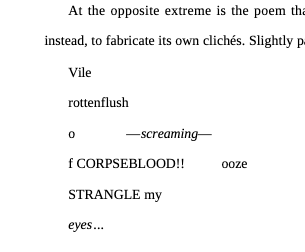
Screenshot 2019-05-24 at 12.51.15The venerable X. J. Kennedy used a poem about “vile rottenflush”
to illustrate bad poetry in his seminal textbook,
Introduction to Poetry.

The poem, he explains, was submitted to the equally venerable
Paris Review, but he does not credit (blame?) the author.
The poem about vile rottenflush, he clarifies, is too personal
and subjective to speak to anyone other than the person who wrote it.
He says, “the author has vented personal frustrations upon words,
instead of kicking stray dogs.”

Who am I to question the wisdom of someone
as accomplished as X. J. Kennedy?
I only know that I remember the phrase “vile rottenflush”
four decades after first hearing it. Also, I think the author of “vile rottenflush”
had witnessed a death of someone much loved, and anyone who has watched
the most cherished people in their lives die might understand the poem, after all.

I think this because the poem also mentions “corpseblood” and “ghastly stench.”
No one forgets the smell of a soul leaving the body.
And no one forgets what they see when life is flushed away.
Perhaps “rottenflush” was a novel way of avoiding the now
clichéd references to “putrefying flesh.”
Perhaps it is a way of reminding the readers
That our blood will cease to flow, pulse, and pump,
Only to be left to pool, drip, and stink.

The author of “vile rottenflush” might be accused of being too direct,
But not too personal. Which of us will not overwhelm
Post mortem viewers and handlers with our own
Ghastly stench, reducing them to cries or horror
As they see their fate clearly in our eyes?