Is there a wrong way to grieve?

Over the past few months, I’ve written of several philosophers of the ancient past who taught that grief should not overwhelm us before themselves becoming overwhelmed by grief. Stoic philosophers taught that we should understand that death is nothing to fear or mourn, if only we can have the proper understanding, but the emotion of grief trumps rational explanations every time. I would conclude, then, that we should not attempt to suppress or diminish our grief but should let it unfold naturally and grieve for as long as necessary. Criticizing the grief of others seems counterproductive at best.

But this left me wondering whether there is a wrong way to grieve. What obligations can the bereaved have to others? Obligations to the dead? Does grief suspend normal obligations?

Like the rest of the world, I don’t know what caused Spc. Ivan Lopez to go on a shooting rampage at Ft. Hood. He certainly had experienced a great deal of stress in his life and had good reason to experience problems with mental health. According to a CNN article by Ray Sanchez, Lopez’s father said the recent deaths of his mother and grandmother, medical treatment, and changes related to transfer of military installations “surely affected his condition.” Grief often becomes unmanageable when it is combined with other complications, obstacles, and challenges. We do well not to ignore the impact of grief on those around us. We are part of a community, and the health of the community deals in part on how well we respond to grief.

For an example from fiction, I’m reminded of “A Rose for Emily” by William Faulkner. Emily has much to grieve for: When she loses her father, she loses a loved one but also status, wealth, predictability, and honor. She responds by simply refusing to acknowledge her loss. In the beginning she denies that her father is even dead. Eventually, she relents and permits him to be buried, but continues her life as if nothing has changed. Her neighbors go along out of pity, not respect. As you probably remember, Emily eventually takes a lover from out of town, kills him, and sleeps with his body for the rest of her life.

Emily’s neighbors had tried to offer condolences to her when her father died, but she denied his death. After his death, the neighbors reacted to her with a mix of compassion, respect, suspicion, and disgust, but they also lacked the will to intervene as Emily continually pushed them away. They left Emily with her privacy and, as much as possible, a little dignity, which only led her to more extreme and destructive measures.

If I say that Emily grieved unethically, you may say that grieving wasn’t the core problem; rather, she was refusing to accept change. But grief is always a reaction to change, and all change is annihilation. The bereaved will often say the whole world changed, and that is exactly what has happened. Emily’s world changed, but she refused to accept either her father’s death or her change in fortune. By killing her lover, she tried to preserve a moment forever. Emily’s response to grief was understandable but not excusable. Then again, perhaps her neighbors did not respond ethically to Emily’s grief. The neighbors did reach out to Emily, even with follow-up visits, but failed to intervene more forcefully. Are they obligated to take matters into their own hands?

I recently had the opportunity to hear author Cheryl Strayed speak on her latest book, Wild, which is about Strayed’s own response to her mother’s death. Strayed is a talented and courageous writer and proficient speaker. As she talked about her grief journey, she only lost her composure once. She said that after her mother’s death she became the kind of daughter her mother would not have wanted her to be. She described her adultery, promiscuity, and substance abuse through tears that evaporated as she moved on to discuss how she began to manage her grief more positively (ethically?).

I ask whether there is an ethical way to grieve. We can see that people, overcome by grief, behave in ways that are certainly unethical in most contexts, but we may have such compassion for the bereaved that we soften our judgment of them. “What she did was wrong,” we may say, “But I can see why she did it. I might have reacted the same way.” But this may be true anytime someone acts unethically. In the exact same situation, I may have acted as Bernie Madoff acted. In fact, we have all acted in unethical ways. We had our reasons (grief, exhaustion, addiction, depression, or whatever), but our actions were unethical.

So what helps people behave more ethically? Jean-Paul Sartre, the famous Existentialist philosopher, says that with each of our actions we choose “the good.” He doesn’t mean we always make good choices, but given our options, we choose the one we thought was best, which means we write our ethical values for public view by the actions we choose. In this environment, other people become our hell. Nothing is more damaging to us than being trapped by the others’ perceptions of us.

When we choose an action, we are choosing the one that seems best to us at the time. The problem is that some of us have run out of good ideas for what to do. We often explain ourselves, rightly, by saying, “I didn’t know what to do!” If we had more ideas, we would have more choices and could make better decisions. Sartre claimed we have absolute freedom, but really we can increase our freedom by increasing the number of actions we have in our consciousness. Sartre saw others as our judge, jury, and executioner, but they can also become our community.

It is Sartre’s companion and lover who had a broader vision for existentialist ethics. Simone de Beauvoir was able to see the positive importance of others in our lives. Beauvoir declares “freedom can be achieved only through the freedom of others.” If we want to be free, we must seek our freedom through the freedom of our community, and our freedom grows out of our love. Beauvoir says, “If we do not love life on our own account and through others, it is futile to seek to justify it in any way.” Without valuing others, our life truly loses meaning, and we will lose all hope.

When I was in China, I once thanked someone for helping me with a problem, and she responded, beautifully, “When we help each other, we are free.” Indeed, it is the only way for us to become free. And it is the only way for us to have more good ideas of what we can do.

Why I hate Steak and BJ Day

On March 14, I learned of a new holiday known as Steak and BJ Day. Known as a humorous response to Valentine’s Day, the idea behind Steak and BJ Day is that women get all the attention on Valentine’s Day (men spend about twice as much as women) and there should be day for men to get what they enjoy, which is, obvious to the creators and celebrants of this day, steaks and blow jobs. It’s just a joke. It’s all in fun. If you don’t like it, don’t participate.

Many women seem to feel this is a fair way to compensate men for being so generous on Valentine’s Day, apparently having no qualms describing their romantic relationships as blatant prostitution. (“After all the trouble he went to for Valentine’s Day, I owe him something. Teehee.”) If people want to live their lives exchanging gifts for sexual favors and cooking services, I have no problem with it, so long as everyone knows what is going on and feels comfortable commodifying relationships. I have a different problem with this holiday.

Steak and BJ Day is based on a crude masculine stereotype that is inoffensive to men who live for their next steak and treat of oral sexual gratification. All men are supposed to want this. Any man who doesn’t love and know how to prepare steak, in fact, should turn in his man card, according to this web site.  Again, it is just a joke. If you don’t love steak, you are just a girl. Hilarious. I mean, who would want to be a girl? It isn’t meant to offend anyone. Any man who objects to this stereotype is himself at risk of being told he is too sensitive or not a “real man” or a “typical man.” People who are less kind will tell him he is a sissy, wimp, girl, or any number of nastier anti-gay slurs.

So, men who don’t want these things should turn in their man cards (see this site for an uproariously funny rendition of this ). “Turn in your man card” is the functional equivalent of “you throw like a girl.” As much as people insist this is all just a joke, the consequences of masculine stereotypes are severe. Children who fail to express their gender in expected ways are more likely to be bullied and abused and suffer from depression and PTSD (see a study on the risk here). You may have heard what happened to a boy who liked My Little Pony. Further, anti-gay attacks are typically in reaction not to sexual activity but to perceived non-conformity to gender stereotypes (a 1982 study by Joseph Harry found that “effeminate” men are twice as likely to be victims of gay bashing than gender conforming men), which means gay-bashing victims include many heterosexuals or children with no obvious sexual orientation or identity at all.

This bias against unmanly men is nothing new. Through an essay by Elizabeth V. Spelman, I found a passage in Plato‘s Republic describing what kinds of men would be inappropriate for a decent society:

We will not then allow our charges, whom we expect to prove good men, being men, to play the parts of women and imitate a woman young or old wrangling with her husband, defying heaven, loudly boasting, fortunate in her own conceit, or involved in misfortune and possessed by grief and lamentation—still less a woman that is sick, in love, or in labor.

People sometimes want to credit Plato with an early form of feminism, because he felt women should be trained in the mode of men. Like many today, he felt it was quite admirable for women to strive to “achieve” masculine traits. Men being the highest form of human perfection, Plato thought it made sense for women to strive for the masculine ideal. The man who would follow the lead of women, however, would be lowering himself below his station and be pathetic at best. His view persists as we encourage girls in sports, mathematics, and leadership, but forbid boys from nurturing, crying, creativity, and careers related to care and empathy. It seems odd to me that eating meat is considered particularly masculine, but vegetarian men are portrayed as being the least manly of all. The hatred and devaluation of “feminine” men is an extension of the oppression of women. Feminist philosopher Jean Grimshaw points out that the conception of a feminine ideal depends on “the sort of polarization between ‘masculine’ and ‘feminine’ which has itself been so closely related to the subordination of women.”

The hatred of “effeminate” men is an extension of the devaluing of the feminine, but it leads to violence and oppression of both men and women. In order to be free, we must assign equal value to all human activities and emotional dispositions. Leadership and assertiveness have their value, but we will not last long in a society devoid of nurturing, care, and concern. Another feminist philosopher, Genevieve Lloyd, puts it this way:

If the full range of human activities–both the nurturing tasks traditionally associated with the private domain and the activities which have hitherto occupied public space–were freely available to all, the exploration of sexual difference would be less fraught with the dangers of perpetuating norms and stereotypes that mutilated men and women alike.

I added the emphasis on the word “mutilated,” because I am grateful to her for using such strong language to describe accurately what sexist stereotypes have done to us. I often hear women struggle to describe how sexism hurts men. Some say it discourages men from working hard or from caring for others, but they miss the fact that sexism destroys men from the inside out. Very few men escape childhood without having their masculinity questioned and challenged. And too many men have responded violently to a woman who has taunted them with, “If you were a real man, you’d . . . !” The constant demand that a boy or man prove his resilience, indifference to pain and fear, and lack of compassion rends men from their humanity. Those who resist are often trampled under foot and left with depression, addiction, anxiety, and self-loathing. Too often, it ends in self-destruction through addiction, isolation, or suicide.

You may be thinking I take things a little too seriously. No one would kill himself over Steak and BJ Day. I agree, but I am asking you to consider the good of masculine stereotypes, and I tell you they serve no purpose and provide no benefit. The cumulative effect of such stereotypes is to prevent men from being whole and to destroy those who are uninterested or unable to fulfill the social expectations such stereotypes are designed to enforce.

For the love of humanity, please free us all.

See also: Why I Hate Valentine’s Day

Why I Am Afraid To Die

Ben Jonson's Lucretius
Ben Jonson’s Lucretius (Photo credit: Catablogger)

My interest in the topic of this blog arose several years ago from a conversation with a scholar visiting from China. She had studied Christianity in China and was interested in meeting Christians in the United States and learning more about their beliefs and culture. She admitted to me that she felt some disappointment to learn that a promise of a blissful eternity did not seem to decrease the fear of death for most American Christians. If life is filled with pain and challenges, why would Christians not welcome a release to a joy of eternity?

Lucretius would not be surprised by their fear. He noted that those who boast of fearlessness in the face of death will react to death in pretty much the same way everyone else does. He says:

“These same men, exiled from their country and banished far from the sight of their countrymen, stained with some foul crime, beset with disease heralding approaching death, keep going all the same. To whatever situation they come in their misery, in spite all their talk, they sacrifice to the dead, slaughter black cattle, and lay out offerings to the gods of the dead.”

Of course, we also know some turn to suicide, which may or may not reflect a loss of fear of death. It may only mean a fear of the misery of life has overtaken a fear of death, but I will return to that idea later.

On the other side, I can remember discussions with Christians describing the attitude of suicide bombers in armed conflict. I have heard at least a few people who equate a willingness to die for a cause with a lack of respect for the value of life rather than a lack of fear in the face of death. If we value our lives, must we fear death? Is there a greater moral advantage to reducing the fear of death or to emphasizing death as a loss of something of great value, life?

Epicurus
Epicurus (Photo credit: Ian W Scott)

Epicurus, who inspired Lucretius, felt our lives would be enhanced if we could extinguish, or greatly reduce, our fear of death. Epicurus said, “Death, the most dreaded of evils, is nothing to us, because when we exist, death is not present, and when death is present, we do not exist.”  Death is a harm because it robs us of the good of life, but it is a harm that is impossible to experience. Some will say that they don’t fear being dead but fear the process of dying, but Thomas Nagel points out succinctly and convincingly that we “should not really object to dying if it were not followed by death.” Both Nagel and Epicurus argue that death is bad because it deprives us of life, but no amount of life is sufficient to eliminate the harm. No matter how long we extend life expectancy, we will view death as a harm to us.

S. Collings Boswell & Johnson 448
S. Collings Boswell & Johnson 448 (Photo credit: Wikipedia)

Of course, some of us face death with more equanimity than others. Scottish author James Boswell visited Scottish philosopher David Hume on his deathbed and was impressed by Hume’s serenity. Boswell mentioned Hume’s calm to Samuel Johnson, but Johnson refused to believe Hume was not covering his fear. In response, Boswell tells us, “The horror of death which I had always observed in Dr. Johnson, appeared strong tonight. I ventured to tell him, that I had been, for moments in my life, not afraid of death; therefore I could suppose another man in that state of mind for a considerable space of time.” Johnson responded, “The better a man is, the more afraid of death he is, having a clearer view of infinite purity.” Our fear of death may, indeed, aid our moral development.

Brush drawing of German philospher Martin Heid...
Brush drawing of German philospher Martin Heidegger, made by Herbert Wetterauer, after a photo by Fritz Eschen (Photo credit: Wikipedia)

While he doesn’t have much in common with Samuel Johnson, German philosopher Martin Heidegger also sees some advantages to our uneasiness with death. When we contemplate our own annihilation, he says, we are filled with dread, which forces us to confront what is authentic. When we are projected into Nothing, we are transcendent. If we were not “projected from the start into Nothing,” we could not relate to “what-is” or have any self-relationship. Only through confronting annihilation do we have any hope for authentic existence.

It may be that our dread gives both our life and our actions meaning. Suicide, which is often seen as a failure to negotiate life, is not necessarily so. Indeed, Simone de Beauvoir sees suicide a possible way to will ourselves free, even in the most horrific situations. She says, “Freedom can always save itself, for it is realized as a disclosure of existence through its very failures, and it can again confirm itself by a death freely chosen.”  If we do not fear our own death, however, this act of defiance and control has little meaning. Willing ourselves free through suicide is only meaningful if it is a triumph over something, and this is not to be taken lightly.

Simone de Beauvoir (9 January 1908 – 14 April,...
Simone de Beauvoir (9 January 1908 – 14 April, 1986) was a French author and philosopher. (Photo credit: Wikipedia)

Fear of death propels us forward through life, even in the face of injury, disease, and extreme hardship, and as it propels us forward it also gives meaning to our struggle. By working to overcome our fear, we establish ourselves as free beings capable of making meaning of our own suffering. And if we will ourselves free and full of meaning, we will strive for others’ freedom as well. Indeed, Beauvoir says we extend our own freedom through the freedom of others.

As a final note, let me say that part of willing freedom for others is an effort to remove obstacles that make suicide seem like a triumph. It is for this reason we should work to promote human capabilities and, specifically, to relieve the pain and suffering of depression.

The Proper Way to Grieve for a Child: Cicero’s Example

Epictetus stated he would embrace death before...
Epictetus stated he would embrace death before shaving. (Photo credit: Wikipedia)

In advising us on how to respond when we encounter someone who has lost a child or suffered an equally calamitous loss, the stoic philosopher, Epictetus said, “Don’t reduce yourself to his level, and certainly do not moan with him. Do not moan inwardly either.”  These negative emotions are dangerous to us and to others, so we must be sure to keep them in check.

This sounds harsh, but Epictetus also advises us not to beat ourselves up when we do give over to grief. He says, “Some who is perfectly instructed will place blame neither on others nor on himself.” Epictetus assures us that death is not to be feared, and our terror of it comes from within, but blaming ourselves for our feelings is also pointless.

Scottish philosopher David Hume, reflecting on the nature of tragedy in art, makes a comment about the best way to comfort a parent who has lost a child. Hume says, “Who could ever think of it as a good expedient for comforting an afflicted parent, to exaggerate, with all the force of elocution, the irreparable loss which was met with by the death of a favorite child?” I’m sure Hume is right that we shouldn’t exaggerate the loss, but I would also advise against minimizing the loss in any way, which is what Cicero’s friend, Servius Sulpicius Rufus,  did after the death of Cicero’s daughter, Tullia.

David Hume
David Hume (Photo credit: Wikipedia)

Sulpicius said, “If you have become the poorer by the frail spirit of one poor girl, are you agitated thus violently? If she had not died now, she would yet have had to die a few years hence, for she was mortal born.” Sulpicius sounds harsh in this instance, but this is actually offered only after he introduced the topic, saying, “If I had been at home, I should not have failed to be at your side, and should have made my sorrow plain to you face to face. That kind of consolation involves much distress and pain, because the relations and friends, whose part it is to offer it, are themselves overcome by an equal sorrow.” If he had been available, he would have comforted Cicero and perhaps avoided the need for such harsh and critical words later, apparently.

Cicero, Kopiezeichnung einer Büste aus London ...
Cicero, Kopiezeichnung einer Büste aus London (Herzog Wellington) (Photo credit: Wikipedia)

Cicero expressed his gratitude for the comforting words laced with recrimination, but also acknowledged their ineffectiveness, saying, “For I think it a disgrace that I should not bear my loss as you – a man of such wisdom – think it should be borne. But at times I am taken by surprise and scarcely offer any resistance to my grief, because those consolations fail me.”

Cicero had also been writing consolations for himself, and he felt himself the inventor of this type of self-help. He said, “Why, I have done what no one has done before, tried to console myself by writing a book.” (This is quoted by Han Baltussen in the Nov. 2009 issue of Mortality in an essay titled, “A grief observed: Cicero on remembering Tullia.”) Unfortunately, Cicero’s Consolations have not survived the passage of time, so we can only infer what they may have said. In a letter to Titus Pomponius Atticus, Cicero remarked that he wrote in order to heal, but his writing also kept him out of public view, preserving the privacy of his grief and avoiding a vulgar display of emotion.

Cicero also took his turn in consoling others, Baltussen notes, “In the examples where Cicero aims at consoling others, we find a subtle approach, developing, as it were, a ‘philosophy of empathy,’ in which he consciously or unconsciously takes personal and political aspects into account. He shows great sensibility in narrowing or widening the emotional gap between him and the consolee.” Cicero noted that one task as consoler was to establish that he needed consolation himself, as he was grieving for his friend’s loss. I think this goes a little beyond mere empathy. Cicero actually feels his own sorrow upon hearing of the sorrow of a dear friend. He understands the friend’s pain because it is a magnified form of his own pain.

I personally feel that Cicero’s struggle with his grief highlights a social failure to deal with grief constructively. Can we not manage to express and process grief openly without fear of censure from friends and counselors? Since the time of Cicero, we have developed grief therapy, expressions of support for the bereaved, and paid lip service to the process of healing. Yet, we still criticize those who can’t “get it together” within a short time. Sadness is seen as weakness, especially for men, and we do not tolerate prolonged grieving. Cicero was lucky to have friends and the ability to spend time grieving and writing his consolations. Men with less power would have had no option but to keep working without respite.

Grief
Grief (Photo credit: tombellart)

As for me, I don’t know the best way to console others, but I’ve thought a little about what kinds of consolations have helped me in the past, and these are the things that I appreciate. First, recognize that my pain is of such a magnitude that it obscures the horizon, and I can’t see beyond it. Second, do acknowledge the enormous value of the life I have lost. Third, do remind me that the person I lost had life filled with wonder, love, accomplishments, and happiness. Fourth, remind me also that this person is in a state of peace with no more struggle, pain, or discontentment. Finally, and perhaps most importantly, assure me that I am not alone in the world, my grief is justified, and that a future is possible.

The Ethics of Caring and Seasonal Depression

I don’t know if it is the changes in the weather, the length of the days, or what, but we

The suicide
The suicide (Photo credit: Wikipedia)

sometimes find the world slipping away from us. As we reach, objects, people, and activities seem to continuously recede into the distance just beyond our grasp. We forget how to be engaged with even the most basic tasks. Seasonal changes can leave us feeling depressed and melancholy. As the poet Phillip Larken put it:

The trees are coming into leaf
Like something almost being said;
The recent buds relax and spread,
Their greenness is a kind of grief.

For reasons that aren’t completely understood, spring seems to bring a surge of depression and suicides, but winter gets all the attention for warnings about seasonal depression. Some researchers have noticed that suicide spikes coincide with increased pollen production.  Apparently, allergies release cytokines, which affect appetite, activity, sex drive, and social engagement. There may be a philosophical question in there as to the difference between having “depression” and having a response to allergies that looks a heck of a lot like depression. Sufferers of either will probably not worry the distinction too much.

Some theorists suggest that suicide peaks in spring because of a “broken promise effect.” When spring doesn’t bring the joy and energy it generally promises, the depressed are moved to suicide. Others have suggested that springtime brings more energy and agitation (and a corresponding drop in melatonin), especially to people with bipolar disorder, that moves them to act against their own lives.  Still others speculate that springtime increases in serotonin give people the energy to kill themselves.

I don’t want us to turn away from people who are depressed during the holidays. Rather, I just hope we can remember that some of us occasionally feel depressed and hopeless throughout the year. The extra effort we make through the holidays may be worth making year round.

Still, I know it is true that many of us mourn with greater intensity during the holidays as we count all those who are no longer with us and grieve for our losses, so maybe we should be a little extra careful during December. A little care can go a long way to avoiding a holiday crisis. But we should remember to keep caring and reaching out during the new year, into spring, and for the rest of the year. When we help each other, we are all stronger.

The Ethics of Grief

It seems each time I attend a funeral, I overhear someone being criticized for grieving too subtly, too gregariously, too privately, or while dressed inappropriately. I dismiss the critics as judgmental and ignorant cranks who should have better things to do. We all know that each person grieves differently. We should all be allowed to grieve in our own time and in our own way.

But I wonder whether there is am improper way to grieve. Many of us tell our loved ones not to cry for us when we are gone. We’d rather imagine they will have a party to celebrate our life. We would like for them to pay tribute to us through their own joy. And when people ask us to do this, we promise them we will, even though we know we won’t. We make an impossible promise out of respect for those we love.

But some people take such promises seriously. This past week, I came across a paper by Amy Olberding that discusses different approaches to grief by Seneca and Zhuangzi. In letter 63, Seneca counsels his friend, “We, however, may be forgiven for bursting into tears, if only our tears have not flowed to excess, and if we have lost a friend, nor let them overflow.  We may weep, but we must not wail.” But Seneca goes on to confess that he wailed excessively over the loss of his friend, Annaeus Serenus.

Seneca
Seneca (Photo credit: tonynetone)wailed excessively over the loss of his friend, Annaeus Serenus.

He admits the power of his grief, but admonishes himself, “I must be included among the examples of men who have been overcome by grief.  Today, however, I condemn this act of mine.” In describing Seneca’s position, Olberding says grief for Seneca is “a form of self-injury that neither effect relief from pain nor alter the event that stimulated it.” As a Stoic, Seneca claims that death should not be seen as an injury, so it is wrong to grieve something that is not actually harmful. Many Christians find themselves in a similar state. Should we not celebrate someone’s passage to a blissful eternity?

English: Zhuangzi dreaming of a butterfly (or ...
English: Zhuangzi dreaming of a butterfly (or a butterfly dreaming of Zhuangzi) (Photo credit: Wikipedia)

And Zhuangzi, the Daoist, finds himself in a similar state. Zhuangzi taught that death is a mere transition to another state and nothing to grieve at all. Olberding says the Daoist views death as part of a “global harmony that sustains the natural world.” But when Zhuangzi’s wife died, he also reacted with extreme emotion. He said, “I with my sobbing knew no better than to bewail her. The thought came to me that I was being uncomprehending towards destiny, so I stopped.” Unlike Seneca, Zhuangzi did not express any self-recrimination over his grief.

Whether we consider it appropriate or not, the feeling of grief when something of great value is lost is universal. We are shocked when someone seems unaffected by the loss of someone who should be valued. With later reflection, we can reassess our grief and our loss more rationally and understand death in a larger context, especially if we have, indeed, learned to live without our valued loved one.

In Buddhism, Kisa Gotami also learns to reevaluate her grief after some reflection and guidance from the Buddha and her neighbors. Kisa Gotami had a young son who died, and she carried his body from person to person seeking aid to revive him. Finally, she was directed to the Buddha who asked her to obtain a mustard seed from every house where no one had lost a child, spouse, parent, or friend. After she couldn’t gather even a single seed, she judges herself for being selfish in her grief while remaining ignorant of the suffering of others.

The Buddha tells her, “In whatever manner people think a thing will come to pass, it is often different when it happens, and great is the disappointment; see, such are the terms of the world.” Even when death is expected, it is painful, but surprise intensifies the pain. The loss of young and healthy friends, siblings, and children often shatters the narrative people tell themselves about how the world works.

The advice of Seneca, Zhuangzi, and the Buddha all seem to be good advice, so long as we acknowledge that no human can suppress an immediate expression of extreme grief when faced with loss of someone so valued. As time passes, we may benefit from reminders that death is a transition, that death is universal, and that we can, indeed, live on after our loss. I do realize there are cases where survivors do not seem able to live on after loss, and compassion should move us to try to help those who are crippled by grief or loss of support.

It is true that people grieve in their own way and their own time, but compassionate care, free from judgment, might help people reach acceptance of the reality of a world that often seems to lack moral order, fairness, and predictability.

Grief and the problem of meaning making

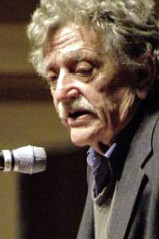
Kurt_Vonnegut_at_CWRU
Kurt_Vonnegut_at_CWRU (Photo credit: david_terrar)

I’ve been reading Kurt Vonnegut again. It is a bad habit I started as a teenager. When I began reading Vonnegut, I was a classic example of a depressed teenager, or at least that was how I saw myself.

Looking back, I realized I had many reasons to be sad. Extremely sad, even. A friend had died in a motorcycle accident when a car pulled in front of him in our own neighborhood, and then my uncle, who was 25 years old, died in a fire that consumed the mobile home he was living in. Of course, a few other bad things happened, too, and the world just seemed a little crazy to me, not fair at all.

My confusion was confounded by the fact that I would often hear family members ask one another, “Do you think someone is trying to tell you something?” They searched each devastating event for a message from God. If something bad happened, it was because we had done something wrong. At church, I learned that all the pain, all the trials, and all the trauma was part of God’s plan, even if no mortal could make heads nor tails out of the plan. I hadn’t read Kierkegaard yet, but I was told to take a “leap of faith,” and then I was thrown off a cliff of faith.

Søren Kierkegaard (Copenhague)
Søren Kierkegaard (Copenhague) (Photo credit: dalbera)

So, around that time, I read about Kurt Vonnegut’s unlucky sister. In the prologue to Slapstick, he told of how while his sister, Alice, was dying of cancer, her husband, who was to take care of their children after her death, died on “the only train in American railroading history to hurl itself off an open drawbridge.” It was bad luck—bad enough to make you feel a little depressed.

But Vonnegut always made me feel better about things. He said, “Since Alice had never received any religious instruction, and since she had led a blameless life, she never thought of her awful luck as being anything but accidents in a very busy place.” Although I have received prodigious religious instruction and led a life full of blame, that one line has gotten me though many dark moments.

Over the years, I’ve heard many people tell me that bad things were part of some tortuous plan by some deity or other, I’ve heard that children are only on earth as a “loan” from God, and I’ve heard that God won’t give us more than we can handle. It seems to me that people routinely get more than they can handle. Many people die from stress-related illness or suicide, brought about by despair and a massive inability to cope with life’s tribulations.

Ah, but the people who didn’t survive just didn’t have enough faith to get by. The message I got from this was: “Be strong—or God may kill you.” If I had no faith in the purely accidental nature of bad luck that I learned from the Vonneguts, I am not sure I could have survived my life, which really only has the normal amount of sorrow and trauma. I haven’t been spectacularly unlucky, even by first-world standards.

Thanks to some of the interpretations I have heard of the meaning of traumatic events, I get a little nervous when anyone starts talking about making meaning of suffering. I’m quite happy to believe that suffering is just one of the vagaries of an existence fraught with peril. According to a paper by psychologist Robert Neimeyer and his coauthors, people have an intense need to “make meaning” after an extreme event disrupts their life narrative. Through a process of making meaning, individuals are able to restore a coherent narrative of their lives.

Part of the problem, it seems, is that most people believe the world has a certain moral order, and that people who are good will be rewarded with positive outcomes. So, when bad things happen, we will surely ask, “Why me?” This is a question Alice Vonnegut never asked herself, according to her brother, anyway. The horrible luck she had did not interrupt her narrative because her narrative was one of randomness and accidental events.

Regardless of what narrative one tells regarding the moral order of the universe, many people do see their own moral or spiritual growth as a result of suffering. Indeed, when we meet young people who are self-satisfied and callous, we often think that they will grow as they meet with grief and loss, and that growth will bring wisdom. It is good to know that our loss can make us better people, but I can’t think of a time when I would not give up my personal growth in order to have a loved one restored.

It seems somehow wrong, ethically wrong, to look toward loss as an opportunity for growth, but we do not seem quite so bothered by looking backward to a loss as a catalyst for growth. Herein lies some of my discomfort with focusing too clumsily on making meaning—it almost implies approaching loss by asking, “What can I get out of this?” Alternatively, it invites people to celebrate what they gained from loss. This, in itself, can create moral distress.

To be sure, psychologists such as Robert Neimeyer emphasize accompanying the grief-stricken on their own journey without guiding them down any particular path. People will, naturally, have to determine what their loss means and also what meaning they assign to life after their loss. If they fail to find any meaning, they may lose their lives all together.

In the quest for meaning, though, I hope we can accept that we live in a world full of hazards, and they do not affect us in any rational order. It turns out that some really awful people live rather charmed lives, and the purest and most compassionate people in the world suffer, though not always.

If we have the strength, we put one foot in front of another one more time. And, maybe, once again.

The proper way to grieve for a child

I hate Galveston.

When I look out over the seawall, I find no peace in the sounds of wind and wave or comfort in the roiling swirls of water gently crashing into the jetties. I see only the bodies of children being dragged and slammed with senseless violence against the sand just beneath the waves. As I look out over the Gulf of Mexico, I see only a sadistic child-eating monster mocking the hole in my chest.

And May is the cruelest month, because it was Mother’s Day in 1992 that I lost my niece and nephew to the powerful spring rip tides along the coast of Galveston. My niece, Cindy, who was seven, was pronounced dead on the beach, but my nine-year-old nephew, Doug, was flown to John Sealy hospital and placed on life support. Although the doctors offered us no hope of his recovery, he was kept on life support for 72 hours to monitor his brain activity.

Image
The only photo I have of Doug and Cindy, from 1990.

During that agonizing 72 hours, we did what most families do. We held his hands, stroked his hair, talked to him, read to him, took him his favorite stuffed bear, massaged his legs, and loved him with every ounce of strength we had. At the moment they stopped life support, the Galveston radio station played his favorite song, “Born in the USA.” Yes, we were on the radio. We were on the news. Our family’s grief was broadcast on the nightly news. I avoided the cameras, but the children’s father was there, tears cascading down his face, explaining how he felt about the death of his children. Who needed this explanation?

Perhaps it is surprising, and perhaps it is not, that I decided to enter the medical humanities program at the University of Texas Medical Branch in Galveston. I spent years driving to Galveston and going into the hospital where my nephew died. Sometimes I avoided the building, but other times I went there and sat in the garden specifically to think of what had happened before. When I completed my required ethics practicum, I went on rounds with the doctors in the pediatric ICU—of all places.

As part of this experience, I was able to witness conversations with doctors and the parents of children who would never recover. The doctors were kind, caring, and professional, and every word destroyed me a little. I imagined the conversations the doctors and nurses must have had regarding my family in 1992. I imagined how they debated the proper course to take: how long to keep him on life support, how to break bad news to the family, and how to prepare for the death of a nine year old. I had thought this experience might help me come to grips with my past trauma, but I honestly cannot say it did.

As medical humanists, we study the ways people make meaning of suffering, but I want to tell you with great heartfelt certainty—there is no meaning in the death of a child. And when you try to make meaning of it, you rob me of my grief. I am entitled to my grief. My pain is my own. When you tell me the children were on loan from God, and he has called them home, I am only amazed that you worship a monster and call it God. When you tell me they are in a better place, I want you to know that the world they left behind is immeasurably worse for their absence. When you tell me anything, you amplify my pain and submerge me in the depths of despair with no comfort and no meaning.

What does someone grieving the death of a child need? Solitude. And comfort. Silence. And conversation. A distraction. A project. Time to do nothing. Time to think. Time to cry. Time to scream. Time to fall apart. Time to get it together. There is nothing you can do. But, really, you should try. And you should know when to back off.

I can remember talking to priests, ministers, social workers, counselors, and well-meaning friends. No one can really offer any comfort, but a few people managed to refrain from intensifying the pain. In particular, Robert Schaibly, who was the minister at First Unitarian Universalist Church in Houston at the time, offered sincere condolences with no advice, no explanation, and no demands. He was empathetic and shared my pain without taking it as his pain. No other clerical person I met was able to achieve something that seems so simple. Perhaps the simplest acts require the greatest art.

Commodifying Mindfulness

I attended a presentation last week on the use of mindfulness in marriage and family therapy. I don’t know a lot about Buddhism and would never claim to be an expert. What I do know of Siddhartha Gautama leads me to view his writings as moral writings. In other words, I do not see them as a guide to the good life but as a guide to how to be good. I may have missed the point here, and I’m glad to be corrected, if anyone reads his words differently. I also realize there is room for interpretation. Nonetheless, I don’t think his goal was to teach people to have a more pleasurable existence or to achieve greater success in business. I also wonder as to whether he intended to help people improve their marriages, considering that he abandoned his wife and son when he left for his journey to confront suffering in the world.

Statue representing Siddhartha Gautama.
Statue representing Siddhartha Gautama. (Photo credit: Wikipedia)

The presenter I saw began by mentioning Siddhartha. He said, correctly, that there were four noble truths, but he did not mention what the first three were (they have to do with life as suffering or sorrow, the causes of sorrow, and the extinction of sorrow). The fourth truth is Siddhartha’s dharma, or teaching of “the way.” The word “dharma” is not specific to Gautama. Anyway, Buddha suggests we can achieve enlightenment by following an eightfold path. The presenter I saw mentioned only the seventh fork on the eightfold path, which is mindfulness.

By doing this, he ignored all the negative precepts of Buddha’s teaching. He left out the stuff about avoiding sexual misconduct (interpret how you will), lying, gossiping, killing animals (vegetarianism seems recommended), and a number of other things. Now, Buddhism, as I understand it, has no commandments, so no one is obligated to be a celibate vegetarian who never speaks, but these are suggestions as to how one might find enlightenment, the goal of which is extinction of individual consciousness. Once we are freed from the cycle of samsara, we will pass into a state of universal awareness, which negates the awareness of any individual.

Given that Buddhism does not recognize the existence of individuals and views all sorrow as universal sorrow, it seems unlikely that Gautama intended to help people achieve individual fulfillment. Indeed, when we take action to relieve suffering, the good of the action is not the good of an individual but the good of the universe. Similarly, the suffering of an individual is only (!) the suffering of the universe. To be freed from this suffering, we must no longer think of the individual, we must not think of our selves. So long as we do, life, which is sorrow itself, will continue.

A universe without suffering is a universe without life in it, least of all life that is conscious and driven by individual needs and desires. In Buddha’s scheme, mindfulness is one tool to help achieve this ego-less state. It is a moral guideline. It is not a way to focus on our goals and what is keeping us from them. It is not a way to relax. It is not a way to be happier. It is a way to be good and right. While I am not a Buddhist and will most likely never become one, I still respect the efforts of people to be better people. Buddha abandoned his family and friends to try to save the universe. Maybe he made the right choice, and maybe he did not, but I feel using mindfulness in a superficial manner is disrespectful of the effort. Using Buddha’s teaching to make money is even more offensive to me, but I suppose I’m easily offended.